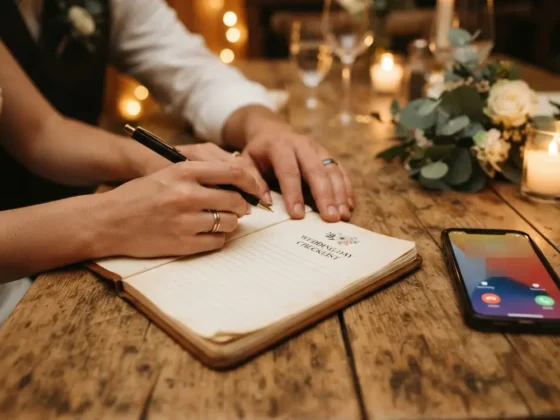
You’re staring at a checklist app at 11pm, cursor hovering between “book venue” and “confirm officiant,” with no idea which one actually goes first. Everyone assumes multicultural weddings just need more time — but the real problem isn’t volume, it’s order, and that’s a completely different fix.
We watched a friend live this out in real time. She was planning from Toronto while her fiancé’s family coordinated the pamamanhikan, a Filipino pre-wedding family meeting, from Manila. A twelve-hour gap that meant the only overlapping window for a video call was 5am her time or 9pm theirs. She kept booking vendor calls first and family-tradition conversations second, then had to unwind decisions twice because the ceremony sequence changed once the elders weighed in. How to plan a multicultural wedding isn’t about cramming in extra tasks. It’s about knowing which decisions have to lock before the next one can even start.
- Nail your guest-count range before you fall in love with a venue. Everything else — catering minimums, date availability, your entire vendor list — takes its orders from that one number.
- If you’re weaving in dual officiants, cultural performers, or a translated ceremony script, start those conversations months before you’d think to. They don’t move at generic-wedding speed.
- Give every tradition you add its own line in the budget, not a shared “extras” bucket. A second caterer means a second deposit schedule, and pretending otherwise is how the math quietly breaks.
How far ahead should you start planning a multicultural wedding?
The average U.S. engagement runs about 15 months, according to The Knot’s 2025 Real Weddings Study — treat that as your outer boundary, not a deadline you’re already behind on. From there, the real question is what happens inside those 15 months, in what order when you’re trying to learn how to plan a multicultural wedding.
Here’s the checkpoint sequence that actually holds up when you’re trying to figure out how to plan a multicultural wedding: lock your guest-count range first, because it determines venue size and catering minimums. Then start your venue search. Then open vendor conversations. Somewhere in the middle of that stretch, most couples launch a wedding website. Bliss & Bone found a median launch time of 8.4 months before the date, which makes a solid gut-check: if you’re past month eight with no site up and no venue booked, that’s your signal to move, not panic.
Multicultural elements push the early end of that window earlier still for couples learning how to plan a multicultural wedding. If you need a religious officiant who’s also comfortable co-officiating with a second faith tradition, or a marriage license process with translation requirements, those conversations need to start before you’ve even nailed down a date range. Learning how to plan a multicultural wedding mostly means learning which of your “later” tasks are secretly “now” tasks.
One honest gap here: we don’t yet have region- or guest-count-specific breakdowns showing whether a 300-guest wedding with three ceremonies needs meaningfully more lead time than a 60-guest one. Until that data exists with real citations, if you’re trying to work out how to plan a multicultural wedding, treat any specific “add four extra months” advice you see elsewhere with a raised eyebrow.
When should you contact and lock the key vendors?
In the UK, 79% of couples who reached out to a venue in 2025 had it booked within four weeks, per the Bridebook UK Wedding Report 2026. That’s a fast turnaround once you’re actually in conversation — and it’s a useful datapoint if you’re trying to learn how to plan a multicultural wedding.
A workable priority order, roughly in this sequence when you’re figuring out how to plan a multicultural wedding:
- Venue. Locks your date and guest cap, so everything else waits on this
- Caterer. Especially urgent if you need more than one cuisine or a halal, kosher, or vegetarian-specific kitchen
- Photographer/videographer. Books out furthest in advance for popular dates
- Officiant(s). Non-negotiable if you’re coordinating two faiths or a civil-plus-religious ceremony
- DJ/band and cultural performers. Travel time matters if you’re flying in a specific musician or dance troupe
- Florist, then planner if you’re bringing one in late to manage logistics
Multicultural weddings tend to push several of these earlier than a single-tradition wedding would. A detail to remember when you consider how to plan a multicultural wedding. A specialty officiant certified in two religious practices is a smaller pool than a generic one. A cultural performer flying in from another country needs travel logistics locked months out, not weeks. And if your date brushes against a religious calendar restriction. Certain fasting periods, inauspicious dates in an astrological calendar, a holiday that shifts your whole family’s availability. That constraint should shape your date search before you ever call a venue.
We don’t have solid 2025-2026 U.S. vendor lead-time data broken out by vendor type, region, and season yet. The UK number above is a useful proxy, not a promise. When that research lands, this section gets a real table instead of a rule of thumb.
How do you sequence multiple cultural ceremonies so the timeline actually fits the venue and vendors?
Start with the legal step, always, when mapping how to plan a multicultural wedding. Your marriage license has a window — apply too early and it expires before your date, apply too late and you’re not legally married when you thought you were. Once that’s locked, sequence your primary ceremony, then work outward to the transitions: costume changes, music cues, and any ritual objects that need staging time between events.
As with all weddings, planning is a marathon, not a sprint. You’ll need to take breaks as you go — each event is its own affair, so take it one step at a time.
Kim DeBose, Lead Planner and Founder, Curated By Kim Weddings and Events
A cross-cultural sequencing checklist worth keeping on hand if you’re figuring out how to plan a multicultural wedding:
- Marriage license timing confirmed against your actual date
- Ceremony scripts translated and shared with both officiants in advance
- Dual-officiant run-through scheduled, not just a group text thread
- Ritual-specific setup time blocked on the venue’s timeline (altar changes, sand ceremonies, tea sets, mandap teardown)
- Costume-change logistics mapped. Where, how long, who’s helping
- Hair and makeup runs scheduled per outfit, not per person
- Rehearsal timing that covers every officiant and every transition, not just the “main” ceremony
Bestie aside: If your rehearsal runs two hours instead of thirty minutes because you’re coordinating two officiants, a costume change, and a tea ceremony nobody’s done in front of a coordinator before. That’s not you overplanning. That’s just what it takes when there’s more than one tradition in the room.
This is the section where a lot of couples quietly discover their venue’s “standard” hour-long changeover isn’t standard for them at all when they’re learning how to plan a multicultural wedding. If you want a sense of how a single-ceremony day typically gets timed before you start layering in extra transitions, our wedding day timeline template is a decent baseline to build from.
Micro, medium, and large multicultural weddings need different timeline skeletons
The shape of your planning timeline shifts with guest count, even before you add ceremony complexity on top — a small but important note when deciding how to plan a multicultural wedding. Here’s a rough skeleton. Treat the months as ranges, not deadlines carved in stone.
| Guest count | Venue + vendor lock | Website launch | Ceremony logistics finalized |
|---|---|---|---|
| Micro (under 50) | 6-9 months out | 4-5 months out | 2-3 months out |
| Medium (50-150) | 9-12 months out | 5.8-11 months out | 3-4 months out |
| Large (150+) | 12-15+ months out | 8-11 months out | 4-6 months out |
The website-launch column leans on Bliss & Bone’s finding that the middle 50% of couples launch between 5.8 and 11.0 months out. A reasonable sanity-check milestone no matter your guest count when you’re trying to figure out how to plan a multicultural wedding. Multicultural elements tend to stretch the right-hand column further, since officiant certifications, second caterers, and multiple costume fittings all eat into that “final logistics” window.
We want to be straight with you here: we don’t have precise, sourced median timelines broken out specifically by guest size and region for multicultural weddings yet. The skeleton above is a reasonable planning scaffold, not a guarantee. If you’re planning a smaller, tighter-timeline wedding, our micro wedding planning timeline guide covers the compressed version of this in more depth.
How should you allocate budget and set contingency reserves for a multicultural wedding?
Your budget needs line items a single-tradition wedding checklist won’t warn you about — exactly the sorts of costs that show up when you consider how to plan a multicultural wedding. Beyond the standard venue, catering, bar, photo/video, planner, flowers, attire, rentals/AV, officiant, and favors, multicultural weddings often add: a second outfit (or three), cultural decor rentals, specialty musicians or performers, and sometimes a second reception entirely.
Build a contingency line into each of those, not just a general “extra” fund at the bottom. A second caterer means a second deposit schedule. A flown-in performer means a second cancellation risk. If our average wedding cost breakdown is any indication, nearly 75% of couples already spend past their original budget on a single-tradition wedding. Stacking traditions without a reserve line is asking for that number to climb faster.
We’re flagging this honestly: current, sourced 2025-2026 cost ranges and percentage allocations by wedding size aren’t in our research set yet, so we’re not going to hand you fake percentages dressed up as data. What we can tell you is where the extra spending shows up, even before we can tell you exactly how much. If the budget spreadsheet is already making your stomach drop, BigDay’s free budget tracker at least gets every line item in one place instead of scattered across three notes apps and a napkin.
What contingency planning should you build in for vendor cancellations and last-minute changes?
Build in four reserve categories, even before you know the exact dollar amounts: a vendor-cancellation reserve, a weather backup plan, a timeline buffer between ceremony transitions, and a surprise-fees reserve for the “oh, that’s not included” line your caterer mentions in month ten.
A practical process, in order:
- Read every contract for cancellation and refund language before you sign, not after something goes wrong
- Keep an emergency contact list — a backup officiant, a backup caterer, a day-of coordinator’s cell number, taped inside your binder or pinned in your planning app
- Map a floorplan alternative in case weather forces an indoor pivot mid-ceremony transition
- Confirm who’s authorized to make a call on-site if a vendor doesn’t show
His Take: I always tell couples to build a replacement window into the timeline itself, not just a mental note to “have a backup.” If your caterer cancels six weeks out, you need actual days blocked on the calendar to find, vet, and contract a new one. Not a scramble squeezed between two other deadlines.
Here’s the catch nobody puts on the checklist: a lot of “non-refundable retainer” clauses don’t distinguish between a vendor backing out and you needing to reschedule. Read the fine print before you assume cancellation protection runs both directions.
The Catch: Most vendor contracts protect the vendor’s deposit if you cancel, but say nothing about what happens to your money if the vendor cancels on you.
We don’t yet have hard 2024-2026 numbers on vendor no-show or cancellation rates, so we won’t invent a “reserve 10% for cancellations” rule that sounds authoritative but isn’t backed by anything real. What we can say, from sitting through enough of these calls: the couples who weather a cancellation calmly are the ones who already had a contact list ready, not the ones who found one in a panic. Our the red flags worth catching before you sign walks through the red flags worth catching before you sign anything.
What are the top planning pain points couples report — and how do you prevent them?
Vendor cancellations, surprise fees, timeline confusion, seating chart standoffs, and plain planning burnout show up constantly in wedding-planning conversations. And multicultural weddings add cultural miscommunication with vendors and contract disputes over unfamiliar rituals to that list.
The prevention tactics are less about willpower and more about paperwork: write a one-page cultural brief for every vendor explaining what each ritual requires and how long it takes, build in extra check-ins at the halfway and eight-week marks, and stack timeline redundancies so one delayed vendor doesn’t collapse the whole afternoon.
We want to flag this honestly rather than fill it with vague reassurance: we haven’t yet pulled representative quotes and frequency data from wedding-planning forums and review sites to back specific percentages here. When that research comes in, we’ll update this section with real numbers instead of “couples often report.”

Quick checklist: what to do in your first 30 days after the engagement
Your first 30 days should cover five things: set a guest-size goal, pick a budget bracket, scan the calendar for religious or family-calendar conflicts, name your must-have cultural elements, and start a short list of venues to contact.
By day 90, you should have reached out to at least a few venues and started vendor conversations for anything with a smaller specialist pool. By month six to nine, aim to have your wedding website live — remember, 8.4 months is the median, so you’ve got room, not a countdown clock.
If you’re the type who needs to see every task laid out in order rather than trusting your memory at midnight, BigDay’s free wedding checklist tool maps this sequence out so you’re not rebuilding it from scratch in a notes app. It won’t hand you region-specific data we don’t have yet, but it will tell you what comes next, which is usually the actual question at 11pm.
Bringing it all together

The anxiety underneath all of this was never really about how much there is to do — it’s about not knowing what order to do it in, and second-guessing every choice because you can’t see the whole sequence at once. That’s the exact gap between a generic checklist and actually learning how to plan a multicultural wedding: the order changes when two families, two officiants, and two sets of traditions are all on the same calendar.
That’s the whole reason we built BigDay’s planner the way we did. Guest list, budget, vendor manager, and seating chart in one place, in a language that works for both sides of your family, so the sequencing lives somewhere other than your head at 2am when you’re trying to figure out how to plan a multicultural wedding. If you’re ready to stop holding the whole order in your memory, Big Day Wedding Planner is built for exactly this kind of layered planning.
Ready to stop holding the whole sequence in your head? The Classic Wedding Planner keeps every ceremony, vendor, and deadline mapped out in one place.
Frequently Asked Questions
How long is the average engagement in the U.S.?
The average U.S. engagement runs about 15 months, according to The Knot’s 2025 Real Weddings Study. That number is a helpful outer boundary for anyone learning how to plan a multicultural wedding, though your actual timeline depends on how many ceremonies, officiants, and vendors you’re coordinating within it.
When do couples typically launch a wedding website?
The median launch time is 8.4 months before the wedding date, with the middle 50% of couples launching somewhere between 5.8 and 11.0 months out, per Bliss & Bone’s research. Use it as a mid-planning checkpoint rather than a strict deadline — if you’re past that window with no site up, it’s a nudge to move, not a sign you’ve fallen behind when learning how to plan a multicultural wedding.
Do couples usually book venues quickly after first contact?
In the UK, 79% of couples booked their venue within four weeks of first reaching out in 2025, according to the Bridebook UK Wedding Report 2026. Comparable U.S. data broken out by weeks isn’t confirmed yet in our research, so treat that number as a directional signal for couples trying to work out how to plan a multicultural wedding. Once you’re in real conversation with a venue, decisions tend to move faster than the anxious waiting period beforehand suggests.