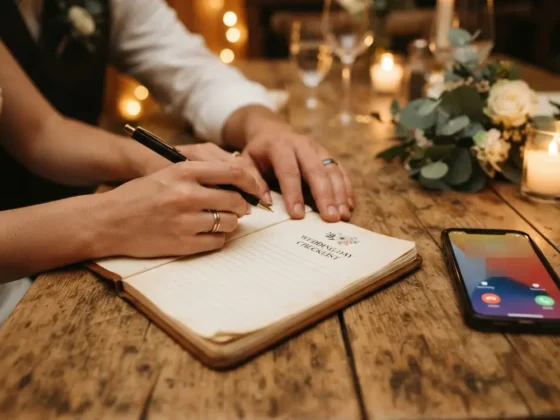
Your countdown app flips to a new number every morning, and somewhere in the back of your head is the assumption that vows are the easy part — the emotional part, the part you’ll dash off the week before. How to write wedding vows isn’t a writing problem. It’s a logistics problem wearing a love-letter costume.
We found that out watching a friend’s wedding outside Savannah go sideways in real time. Her now-husband wrote three full pages, and what he’d rehearsed as five minutes turned into almost nine once his voice caught twice and he lost his place once. The ceremony ran long. The photographer’s golden-hour window, booked to close at 6:40, shut while the wedding party was still standing at the altar. The DJ had already eased into cocktail-hour music one room over, so guests filed out to a soundtrack that didn’t match what was happening behind them. Nobody’s vows caused that. The absence of a plan for them did.
How long should ceremony vows be in a real, run-of-show wedding?
Most 2025–2026 timeline guides put the full ceremony at 20 to 30 minutes, covering processional, readings, vows, ring exchange, and pronouncement combined, according to Sara Does SEO’s 2026 wedding industry statistics roundup. Nobody publishes a national number for ideal vow length specifically, and research on how to write wedding vows is notably thin. That’s a real gap in the research, not an oversight on our part, and it’s worth naming instead of pretending a stat exists.
So here’s our editorial rule of thumb, clearly labeled as a recommendation, not a sourced statistic: if your ceremony runs 20 to 30 minutes total, budget 3 to 5 minutes for both sets of vows combined, transitions included. That’s roughly 90 seconds to 2 minutes per person read at a normal pace, not a performance pace. How to write wedding vows that actually fit starts with reading your draft out loud, timed, at least twice before the week of the wedding.
Run a 10-minute time audit: read your draft aloud once at a slow, emotional pace with pauses to test how to write wedding vows. Add 30 seconds for nerves. If you land over 2.5 minutes, cut a paragraph — not on the day, now. Shorter vows protect the photographer’s light and the DJ’s cues downstream, and neither of them can claw back a closed golden-hour window once it’s gone.
When and how should you share your vows with the officiant, photographer, and DJ?
Photographers commonly plan to arrive 1 to 3.5+ hours before the ceremony starts, and DJs or bands typically arrive about two hours before guests do, per Modern Moments’ 2026 vendor timeline guide. When deciding how to write wedding vows, make sure your vows are in the right hands well before either of them shows up, not exchanged in a parking lot ten minutes out.
Here’s who needs a copy, and roughly when:
- Officiant — full draft before the rehearsal, so they know cue points and can flag if something runs long when reviewing how to write wedding vows.
- DJ or band. The exact timing and any musical cue or intro line 24–48 hours ahead, plus a mic and sound check about 30 minutes before the first guest arrives, to support how to write wedding vows.
- Photographer. Not the text itself, but a heads-up on approximate length and any physical gestures (ring exchange, unfolding a letter) they should be positioned for during how to write wedding vows.
- Day-of coordinator. A backup copy, in case the officiant’s isn’t accessible in the moment.
Format matters more than people think when you plan how to write wedding vows. A paper copy taped inside the officiant’s binder, labeled clearly “BRIDE VOWS” or “GROOM VOWS” with the reading order noted, beats a phone screen that can dim, lock, or die at the worst second. Add any required pauses right on the page. “pause for ring exchange,” phonetic spelling for a name, a translated line if you need one read aloud.
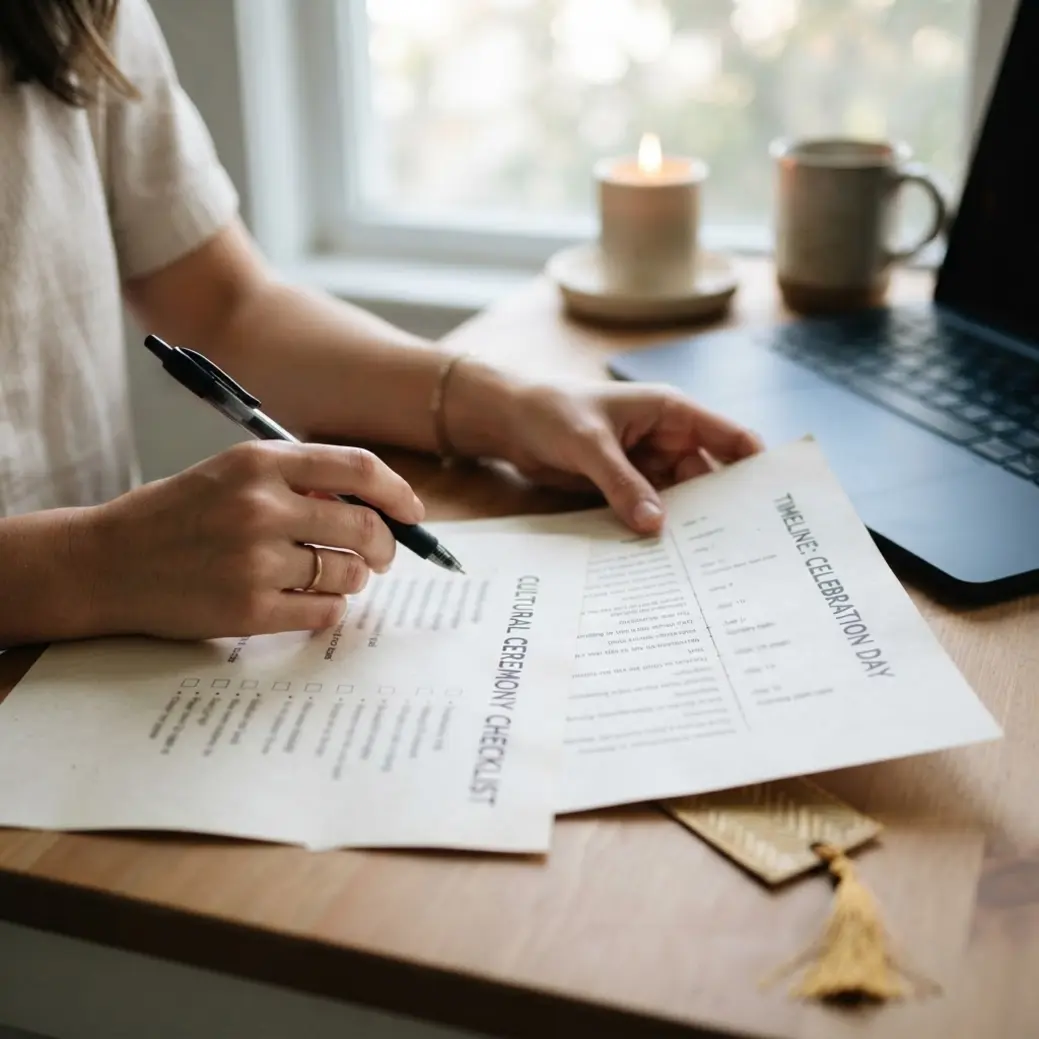
Where do vows sit in a timeline, and how much buffer should you build around them?
Planners recommend 10 to 15 minutes of buffer between every major event on the day, plus a 30-minute cushion before the ceremony even starts, according to Modern Moments. Inside a typical 20-to-30-minute ceremony, vows usually land in the middle: processional, a reading or two, vows, ring exchange, pronouncement. Plan how to write wedding vows with that placement in mind.
Build these buffers directly into your run-of-show:
- 15 minutes before vows begin, to absorb a late processional or slow seating.
- 10 minutes after vows for signing, hugs, and photos before the exit.
- A named fallback: “shorten readings” saves 5–7 minutes if the earlier part of the ceremony ran long.
Someone has to own the decision to tighten things — that’s the officiant or coordinator, not the couple mid-ceremony when deciding how to write wedding vows. Give them a script in advance: “We’ll move straight into the vows now” is enough to skip an extra reading without anyone in the pews clocking it as a cut.
His Take: Set a one-word code with your coordinator before the ceremony even starts. If she whispers “two” to the officiant, it means compress. Skip the second reading, don’t skip the vows. Nobody in the crowd hears a code word. They just see a ceremony that flows.
Who should hold and return the handwritten vows, and what if they get lost?
Competitor timeline guides routinely skip who’s responsible for physical items on the day — the same blind spot shows up around who collects gifts or handles load-in. Vows fall into that same gap. Including decisions around how to write wedding vows. And it’s worth closing before the day, not during it.
Pick one person: the officiant or the day-of coordinator, not both, not a parent who “will probably remember” when figuring out how to write wedding vows. A labeled envelope system beats loose paper in a pocket every time. After the reading, the coordinator collects both copies, photographs them on the spot, and tucks the originals into a labeled envelope stored in the venue office or a coordinator’s bag. Never left on a sweetheart table where a wine glass can find it.
Bestie aside: Make a copy before the week of the wedding, not after. The original in your handwriting is going to matter to you in five years. But only if it survives the reception.
What do vendors need to know about your vows — mic cues, music fades, and photographer angles?
DJs handling ceremony sound should be ready and playing 30 minutes before the first guest arrives, and photographers plan their positioning well ahead of the ceremony to catch vows without blocking sightlines, per Modern Moments’ vendor guide. A vow you wrote for two ears only still needs a functioning mic, a photographer who knows where to stand, and a lighting plan if you’re outdoors after sunset.
Hand each lead vendor a one-page cue sheet with:
- Timestamps for vow start and estimated finish.
- A position map showing where the photographer stands, keeping the officiant’s sightline to the couple clear.
- A required mic check 30 minutes before the ceremony, and who makes an announcement if sound cuts out mid-vow.
- Any interpreter, live-captioning, or translated-line needs, staged in advance so nobody’s improvising with a phone app at the altar.
This is the exact micro-logistics layer most “wedding day timeline” articles never get into. They’ll tell you cocktail hour is an hour, but not who’s standing where while you’re saying your vows.

If a vendor is late or an emergency happens during vows, what’s the contingency choreography?
Vendor no-shows and late arrivals show up constantly in real-couple accounts from 2024–2026 — tent crews arriving a day late, planners running behind and blaming caterers, sudden weather rolling in mid-ceremony, as documented in the New York Post’s 2025 roundup of wedding-day disasters. None of this is quantified as a national percentage, but it’s common enough that a contingency plan earns its place in your binder.
If something breaks mid-ceremony, the coordinator’s checklist looks like this:
- Pause music immediately rather than let it clash with spoken vows.
- If a written copy is unreachable, the officiant reads a short pre-prepped fallback line the couple approved in advance.
- The photographer shifts to candid emotional shots if posed portraits become impossible.
- Escalate to the venue manager only if the fix requires equipment or access the coordinator doesn’t control.
Two scripts are worth prepping with your officiant ahead of time: a “shorten” line that trims a reading on the fly, and a “skip and note for later” line for anything that truly can’t happen in the moment. A toast, a unity ritual, a moment you save for the reception instead. Review your vendor contracts beforehand for what happens with overtime or cancellation remediation; specific national fee data doesn’t exist yet, so the contract language itself is your only real source of truth here.
Quick vow-writing checklist and the micro-timeline to run at rehearsal
A full wedding day typically runs 10 to 12 hours from getting ready to send-off, with the ceremony itself occupying just 20 to 30 minutes of it, per multiple 2025–2026 timeline sources. Rehearsal is where you test whether your vows actually fit inside that window, not the day itself.
Rehearsal checklist:
- Timed read-through of vows with the officiant present, out loud, at ceremony pace.
- Mic check with the DJ or sound tech.
- Photographer position walk-through, confirming sightlines during vows.
- Confirm who holds physical copies after the reading and where they’re stored.
Content checklist for the vows themselves: legible handwriting or large-print type, marked pause points, a ring-exchange cue, correct pronouns, and phonetic notes for any translated or difficult-to-pronounce lines.
Sample rehearsal micro-timeline: 0:00 processional, 4:00 readings, 8:00 vows begin, 2–3 minutes max per person — that last number is our editorial recommendation, not a published statistic, since no national vow-length data exists. Test it at rehearsal and adjust before it’s real.
Conclusion
The panic isn’t really about finding the right words. It’s the fear that something you can’t fully control — your own voice cracking, a reading running long, a vendor running late. Quietly eats into the day you can’t get back. That’s the actual friction behind how to write wedding vows: not the writing, the holding-your-breath part where you hope the whole schedule survives it.
That’s exactly the kind of day-of logistics Big Day Wedding Planner was built to hold instead of you. A run-of-show, vendor contacts, and buffers in one place, so your vows can just be your vows and the timeline takes care of itself, including support for how to write wedding vows.
Frequently Asked Questions
How do vows fit into a 20–30 minute ceremony?
They sit in the middle of the sequence — after the processional and any readings, before the ring exchange and pronouncement, which is why how to write wedding vows should account for flow. Since the full ceremony averages 20 to 30 minutes, vows plus transitions should stay to roughly 3 to 5 minutes total if you want the rest of the schedule to hold.
When should I give my vows to the officiant and vendors?
Give the officiant your full draft before the rehearsal, and give the DJ or band the timing and any cue line 24 to 48 hours ahead, since they typically arrive around two hours before guests. Photographers should get a heads-up on length, not the text, well before their 1-to-3.5-hour pre-ceremony arrival window so they can prepare for how to write wedding vows.
What should the day-of coordinator do if the timeline slips during the ceremony?
They use a pre-agreed script to shorten a reading or trim a transition, protecting the vows themselves rather than cutting them. This is exactly why a timeline buffer. 10 to 15 minutes between major events, plus a 30-minute pre-ceremony cushion. Exists in the first place.
Who should hold the physical copies of the vows so they aren’t lost?
One person only. The officiant or the day-of coordinator. Using a labeled envelope system, with a phone photo taken immediately after the reading as backup. This closes the same gap that top timeline guides leave open around who’s responsible for physical items and handoffs on the day.
Are there venue or legal constraints that can affect whether vows can be read outdoors or at a certain time?
Some venues and municipalities enforce noise curfews or require permits for outdoor ceremonies, which can affect microphone use or the latest possible start time. Confirm any restrictions with your venue and local permitting office well before finalizing your ceremony time, since these rules vary widely and aren’t standardized nationally.