Your dress is back in the garment bag, the thank-you cards are still in a stack on the counter, and the house is quiet in that way that hits different than regular quiet — and somewhere in that stillness, you’re realizing you said yes to hosting a day after wedding brunch without quite figuring out what that actually involves.
Most of what gets written about post-wedding brunches makes it sound like a pleasant little footnote. It is not a footnote. It is a second event, with its own vendors, its own contract clauses, its own budget line items, and its own version of the 11pm “wait, did we confirm the guest count?” spiral. We planned ours while living out of two suitcases — the whole wedding coordinated remotely, details pinned to a shared doc across time zones — and the brunch was the part that nearly unraveled at the end because we’d treated it like an afterthought. The kitchen window at the venue was two hours shorter than we’d assumed. The setup crew’s clock started running at the same time the rental delivery arrived. There was a moment, scrambling on the morning after our own wedding, that felt nothing like the soft, golden scene people post about.
So here’s what we actually know — and, just as importantly, what the 2025–2026 data does and does not tell you — so you can plan this thing without repeating our exact scramble.
Do you actually need a day after wedding brunch?
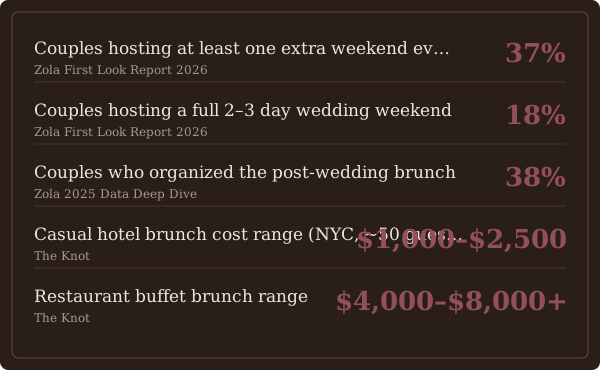
No — and the data backs that up. According to Zola’s 2026 First Look Report, 37% of couples host at least one additional wedding-weekend event, which includes welcome parties, farewell brunches, and anything in between. That means the majority of couples do not host one. It is genuinely optional, and whether it makes sense for you comes down to a few specific things.
The main reason couples host a day after wedding brunch is proximity: out-of-town guests who flew in or drove hours don’t get much time with you on the wedding day itself — you’re in photos, you’re doing first dances, you’re being pulled in fifteen directions. A brunch gives you two relaxed hours to actually sit with your grandmother, your college roommate, your partner’s cousins who you’ve met exactly twice. That part is real and worth something.
The part that gets glossed over: it is a second event. Even a casual come-and-go hotel brunch requires confirmed headcount, a signed agreement, a food minimum, and someone awake early enough to be there when the setup crew arrives. If your wedding ran long, your vendors ran late, and you got four hours of sleep, “casual brunch” still means a 7am alarm.
A quick decision checklist before you commit:
- What percentage of your guests are traveling from out of town? (The higher that number, the more a brunch earns its keep.)
- Does your immediate family have the energy for a second morning? Be honest.
- What does your venue or hotel contract allow — and at what additional cost?
- Is your wedding a single day or a multi-day weekend? (Zola reports 18% of couples host a full 2–3 day weekend — if you’re already in that camp, a brunch is often already baked in.)
One more thing worth naming: no verified 2025–2026 industry survey we found establishes a specific day-after-brunch prevalence rate or attendance percentage. Estimates on planning blogs vary wildly. The 37% Zola figure covers all additional events combined, not brunches specifically. So if someone tells you “most couples do this now,” ask them where that number came from.
Bestie aside: If you want one last morning with your people before everyone scatters to their flights — before the group chat goes quiet and it’s just the two of you again — that’s a completely valid reason on its own, no data required.
Post wedding brunch etiquette: who hosts and who actually pays?
When a brunch is formally invited — meaning guests receive an invitation or a clear heads-up that they are expected — the host pays. The Knot’s post-wedding brunch guidance states this plainly: host pays. The Emily Post Institute’s wedding expenses guidance places a next-day brunch in the traditional bride’s family column, though it also notes that modern couples increasingly split or take on costs themselves.
Hosting models in practice tend to fall into three versions: the couple pays for everything and treats it as a wedding extension; one set of parents hosts (and pays) as a gift; or the couple and both families split it informally. The Zola 2025 Data Deep Dive found 38% of couples reported organizing the post-wedding brunch, while 23% said parental figures handled it — though that survey measured who organized it, not necessarily who wrote the check, so treat those numbers as directional, not definitive.
A few etiquette points the research was silent on, so we’re flagging them as advisory rather than sourced rules:
- Invitations and RSVPs: If it’s a formal sit-down, send a separate invitation (a note tucked into the welcome bag works fine for destination weddings). If it’s truly casual and open-door, a wedding-website post or day-of announcement is common. Set an RSVP deadline — venue food minimums often require confirmed counts 48–72 hours out.
- Tipping: No verified national standard exists. Default to your venue’s gratuity policy and standard local catering practice (typically 18–22% of the pre-tax total). Confirm this with your vendor before the event, not during it.
- Gift opening: No verifiable 2024–2026 source establishes a clear norm here. The practical answer: skip it unless you have dedicated time, a quiet space, and a way to track who gave what in real time. Most couples defer gift opening until they’re home.
- Alcohol service: Whether to serve mimosas is your call; whether you’re allowed to is your venue’s. Alcohol licensing and service rules vary by city and venue type — confirm before you assume.
Note: we searched for updated guidance from named etiquette authorities like the Emily Post Institute or contemporary etiquette columnists specifically on day-after-brunch RSVP wording and tipping, and the 2024–2026 results did not surface direct quotes. The practical guidance above reflects common industry practice, not a named expert citation. If you need an authoritative etiquette source for a formal situation, check Emily Post’s wedding etiquette pages directly.
What does a day after wedding brunch actually cost — and what can’t the data tell you?
Published planning guides show a wide range: roughly $1,000–$2,500 for a casual, come-and-go catered hotel option (NYC example) and $4,000–$8,000 or more for a restaurant buffet, per The Knot’s editorial guidance. A rough per-person estimate cited in some 2025 planning articles is $15–$25 per guest on the low end. These are editorial ranges, not national survey medians — no verified 2025–2026 dataset we found breaks down per-person costs by food, beverage, staffing, venue rental, and gratuity separately.
To give you something concrete to work from, here is an illustrative 40-person sample budget from a 2026 planning guide (labeled as an editorial example, not an industry average):
| Line Item | Illustrative Amount |
|---|---|
| Food | $2,400 |
| Nonalcoholic beverages | $400 |
| Alcoholic beverages | $500 |
| Venue rental | $600 |
| Rentals (linens, etc.) | $300 |
| Total (40 guests) | $4,200 |
Source: illustrative budget example from a 2026 planning guide. Not a verified median — your actual numbers will depend on your city, vendor, and guest count.
What the data genuinely does not tell you: overtime fees (what happens if brunch runs past the contracted window), late-cancellation penalties, minimum spend requirements, and guaranteed-count deadlines. These numbers vary too much by venue and city to generalize, and no standardized 2025–2026 penalty schedule exists in the published research. Every one of those figures requires a direct vendor quote.
If you’re in the middle of budget spreadsheet territory and want a place to track all of it without the chaos of seventeen open tabs, the free BigDay budget tracker lets you drop in line items and actual quotes as you get them — useful for the moment you realize “illustrative budget” and “your actual bill” are going to be two different numbers.
What vendor and contract details are couples actually missing? A checklist planners wish was standard
The honest answer here: the 2024–2026 published research we reviewed did not surface vendor interviews, caterer quotes, or planner reports on operational clauses for day-after brunches. That’s a real gap, and it means the checklist below is built from general catering and venue contract knowledge — not from surveyed data. Get local quotes and read your specific contract before signing anything.
These are the questions to bring to every vendor conversation:
- Guaranteed guest count and deadline. Most caterers require a confirmed headcount 48–72 hours before the event. Your contract will specify a minimum — if attendance drops below it, you pay for it anyway. Ask what that minimum is before you sign.
- Kitchen access and prep windows. When can the caterer’s team access the space? How does that overlap with the venue’s own setup or other bookings? If those windows conflict, you’ll know on the morning of your brunch, not before.
- Setup, linen delivery, and cleanup windows. Who handles removal? When does the strike deadline hit? Venue overtime often starts the minute you go past your contracted end time — and the clock doesn’t pause for a slow cleanup crew.
- Overtime fees and how they’re calculated. Ask for the specific per-hour (or per-half-hour) rate in writing. Research gap callout: no verified national overtime fee schedule exists in the 2025–2026 data — require a local vendor quote with the rate documented in your contract.
- Alcohol licensing and service rules. Can the venue serve alcohol at that hour? Do they require a licensed bartender? Are there noise or permit restrictions that affect a Sunday morning event? These rules vary by city and venue type.
Additional contract points to review (often omitted from planning checklists):
- Preferred-vendor lists and whether you’re required to use them
- ADA accessibility and restroom capacity for your expected headcount
- Contingency plan if a vendor no-shows
- Leftover food and surplus rental liability — who owns it, who removes it
- Parking and shuttle logistics for out-of-town guests
Research gap callout: specific overtime dollar amounts, catering minimums, and kitchen access windows were not available in the 2024–2026 sources reviewed. These require direct quotes from a local caterer, venue manager, and rental company. Do not budget for unknowns by guessing — get the numbers in writing.
Funny how the contract clause you forgot to ask about is always the one that costs you. The “non-refundable minimum” is written by the side that gets to keep it.
For more on navigating what happens in the post-wedding period — including the paperwork and logistics nobody prepares you for — our guide on what happens after the wedding covers the full picture.
When should the brunch start, how long should it run, and how many people will actually show?
The Knot’s editorial guidance recommends a two-hour format for a post-wedding brunch, with planning articles commonly citing a 9–11 a.m. start window. Those are editorial recommendations, not survey averages — but they’re reasonable anchors, especially if your wedding ran late and your vendors need sleep too.
For local weddings, a 10 or 10:30 a.m. start is forgiving enough that guests who stayed late don’t feel punished for it. For destination weddings, check hotel checkout times first — a brunch that ends at noon works better than one that conflicts with the 11 a.m. checkout scramble. A 9 a.m. start is fine if your guests are early risers or have long drives ahead; it is less fine if your reception went until midnight.
On attendance: no verified 2025–2026 figure exists for what percentage of invited wedding guests actually show up to a day-after brunch. Anyone giving you a specific number is estimating. What we’d suggest instead — and label this as advisory, not data:
- Plan your guaranteed count conservatively (60–70% of those who RSVP’d yes, as a planning buffer, not a verified rate)
- Use hotel rooming lists to help predict who’s still in town the next morning
- Set an RSVP deadline that gives your caterer enough notice to hit the count minimum
- Build in dietary flexibility — a brunch menu with clear options for common restrictions (gluten-free, vegetarian, nut-free) costs almost nothing extra in planning and avoids morning-of scrambles
And on pacing: the gap between your wedding’s end time and your brunch’s load-in matters more than most planning guides acknowledge. Vendors doing both events need actual rest between them. Research gap: no verified vendor-fatigue threshold exists in the 2025–2026 data — when booking the same caterer or staffing company for both events, ask directly what minimum turnaround they need. Get that in writing too.
His Take: The attendance estimates stress me out more than they should. My actual advice: set a guaranteed count at the lower end of what you think will show, confirm the RSVP deadline with your caterer, and stop trying to predict a number nobody can verify. The guests who show up are the ones who wanted to be there. That’s the list you’re actually feeding.
If you’re still in the planning phase and want a timeline that accounts for the brunch alongside your main-day schedule, the wedding day timeline template is a useful starting point — and our piece on the wedding day guide mistake that eats time covers the scheduling errors that ripple into the next morning.

The day after: what it’s actually for
A day after wedding brunch is not a required line item on a wedding checklist. It is a choice — and a real one, with real logistics behind it. The 2025–2026 industry data tells you that plenty of couples host some version of it, that costs vary widely by format and city, that the host is generally expected to pay when guests are formally invited, and that a two-hour window is the editorial consensus for length. What it does not tell you: a verified per-person cost breakdown, a national attendance rate, or the contract clause your specific venue is going to spring on you at 7 a.m. on a Sunday.
That gap between “planning guide” and “actual vendor conversation” is exactly where things go sideways. And it’s also where having a system matters more than having a mood board.
If someone in your life is still in the thick of planning — navigating the whole wedding weekend, not just the brunch — the BigDay Classic Edition is built for that exact stretch: the part where the details are real and the spreadsheet stopped being enough. Pass it along if it would help.
And if you’re also navigating everything that comes after the wedding itself — name changes, vendor follow-ups, the emotional reset — our guide on what to do after getting married covers the practical and the personal side of that transition.
FAQ: Day After Wedding Brunch
How common is it to host an extra wedding-weekend event?
According to Zola’s 2026 First Look Report, 37% of couples host at least one additional wedding-weekend event — which includes welcome parties, day-after brunches, and similar gatherings. Separately, 18% host a full 2–3 day wedding weekend. Note that no verified 2025–2026 figure exists for the percentage of couples hosting a day-after brunch specifically; the 37% covers all additional events combined.
Who usually pays for a day-after wedding brunch?
When a brunch is formally invited, the host pays. The Knot’s post-wedding brunch guidance states this plainly. Traditional etiquette (per the Emily Post Institute) historically placed a next-day brunch in the bride’s family’s column, though modern practice varies — the couple, one set of parents, or both families sharing the cost are all common. Zola’s 2025 data found 38% of post-wedding brunches were organized by the couple and 23% by parental figures, though the survey measured who organized the event rather than who paid specifically.
How long should a day after wedding brunch be?
The Knot’s editorial contributors Engleby and Bartling recommend a two-hour format. Planning articles commonly suggest a start window of 9–11 a.m., adjusted for your guests’ travel needs and the previous night’s end time. These are editorial recommendations, not industry survey averages — but a two-hour window is a reliable planning anchor for most formats.
How much does a day after wedding brunch cost per person?
Published planning guides show wide ranges: roughly $1,000–$2,500 for a casual hotel come-and-go option (NYC example), and $4,000–$8,000 or more for a restaurant buffet, per The Knot. A 2025 planning guide places a casual brunch at $600–$1,200 total, with a rough per-person estimate of $15–$25. An illustrative 40-person example budget totals approximately $4,200 across food, beverages, venue rental, and rentals. Important caveat: no verified national median per-person breakdown exists in the 2025–2026 research. All figures above are editorial estimates — confirm your actual costs directly with your venue and caterer.