
Your phone buzzes at 9:14 on a Tuesday night: a vendor quote sitting in your inbox, and the number is almost double what the website suggested. You assumed tight meant manageable. Most couples do, right up until a number like that lands.
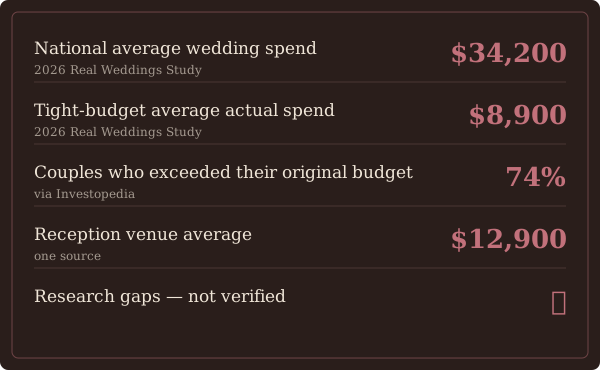
The problem isn’t that you picked expensive vendors. It’s that how to plan a wedding on a tight budget is not the same question as how to find cheap vendors, and nobody in the wedding industry has a real financial incentive to explain the difference. The average couple married in 2025 spent $34,200, according to 2026 Real Weddings Study. If your number has to land well under half of that, the path isn’t one magic tip. It’s a series of real trade-offs that nobody explains upfront.
We know because we watched a friend go through it. She got engaged in late spring, sat down with her partner the same weekend to set a budget they genuinely believed was reasonable, and then started calling venues. Within a week, she was texting us photos of invoices that were nothing close to what the websites had listed. Not because she’d misread anything: the venues just hadn’t included food-and-beverage minimums, service charges, or required rental packages in the headline price. The gap between what she’d planned and what vendors were actually quoting her was staggering. That’s the moment this kind of thing stops being abstract and becomes very personal, very fast.
So here’s what the actual numbers look like, and where the real decisions live.
How to plan a wedding on a tight budget in 7 steps
- Set the number you can pay without borrowing, then hold back 10%. Zola’s 2025 survey found 74% of couples went over their original budget. Plan the buffer in from day one instead of finding it later.
- Fix the guest count before you look at venues. At an average of $80 per person for catering, every 10 guests adds roughly $800 in food alone. The guest list sets the budget more than any vendor does.
- Pick your top three priorities. Photos, food, music, the dress: choose three and go basic on everything else. You can’t trim every line a little and still land at half the national average.
- Choose an off-peak date. Fridays, Sundays and off-season months are where real venue discounts sit, because demand is lower.
- Get three itemised, all-in venue quotes. Ask for minimums, service charges and tax in writing. The headline price on a website is rarely the number you pay.
- Book in the order things sell out. Venue first, then photographer, then caterer. Smaller vendors can wait.
- Track every quote and deposit in one place. Overspending usually comes from a dozen small line items nobody added up, not one big one.
The sections below cover each step in detail: the real numbers, which cuts hurt, and when to book.
What does a tight-budget wedding actually cost in 2026?
Couples who budgeted under $15,000 and married in 2025 spent an average of $8,900 total, according to 2026 Real Weddings Study, which surveyed 10,474 U.S. couples. That is the only verified band available in the current research. There is no universal industry definition of “tight”: the label means different things in different markets, and this post will not pretend otherwise.
That $8,900 sits against a national average of $34,200. The gap between those two numbers is where every real trade-off lives: guest count, venue type, food service style, whether you have a photographer at all. A $25,300 difference does not come from choosing slightly less fancy flowers.
What the research also shows (and what is uncomfortable to say plainly) is that Zola’s 2025 survey of 1,500 newly married couples found that 74% exceeded their original expected budget. That is not a debt statistic. Zola did not report how many of those couples borrowed money or what they owe now. But it does mean that whatever number you write down today, you should budget a buffer, because the majority of couples who planned carefully still went over.
One thing this research cannot give you: regional medians. The available data does not support a city-by-city breakdown, and we are not going to invent one. If you need local numbers, call three venues in your area this week and ask for a full itemized quote, including all mandatory minimums and service charges. That one hour of calls will tell you more than any national average.
Which line items actually eat the budget, and which cheap wedding ideas cut cost vs. cut experience?
The single highest-cost line item for most couples is the reception venue, averaging $12,900 nationally according to The Knot’s 2025 data. Catering runs $80 per person on average, meaning a 100-person guest list adds $8,000 in food costs before any other expense. After those two, the next largest categories are: photographer ($3,000), flowers ($2,800), videographer ($2,300), wedding dress ($2,100), DJ ($1,800), and event rentals ($2,000, per a secondary compilation citing The Knot via WeddingDive).
Understanding how to plan a wedding on a tight budget means looking at that list and asking which cuts reduce what you feel versus which cuts reduce what vendors charge. Those are genuinely different questions.
| Category | Knot Average | Cuts guest experience? | Cuts vendor margin/convenience? |
|---|---|---|---|
| Reception venue | $12,900 | Partially: a backyard or park is different, not worse | Yes: weekday/off-peak pricing is real |
| Catering (per person) | $80/head | Yes, if food quality drops noticeably | Yes: buffet or family-style vs. plated service |
| Photographer | $3,000 | Partially: fewer hours means fewer moments captured | Yes: a half-day package cuts travel and setup time |
| Flowers | $2,800 | Minimally: greenery and seasonals still look full | Yes: DIY or wholesale reduces florist labor cost |
| Videographer | $2,300 | Yes: no video means no video, permanently | N/A if skipped entirely |
| DJ | $1,800 | Minimally with a curated playlist | Yes: a band costs $4,500 on average |
| Wedding dress | $2,100 | Personal: sample sales and consignment are real options | Yes: bridal consignment saves significantly (estimate) |
Those are national averages, not tight-budget numbers. Here’s what a $10,000 budget for 50 guests could look like instead. It’s an example split, not survey data: use it as a starting point and swap in your real quotes.
| Category | Example amount | Share |
|---|---|---|
| Venue + food and drink (about $90 per guest) | $4,500 | 45% |
| Photographer (half-day) | $1,500 | 15% |
| Attire and rings | $1,000 | 10% |
| Flowers and decor (seasonal, greenery-heavy) | $600 | 6% |
| Music (curated playlist + rented speakers, or a short DJ set) | $400 | 4% |
| Officiant and marriage license | $350 | 3.5% |
| Cake or dessert | $300 | 3% |
| Hair and makeup | $300 | 3% |
| Stationery and postage | $250 | 2.5% |
| Buffer for surprises | $800 | 8% |
| Total | $10,000 | 100% |
If venue plus food comes back above half your total, that’s your signal to cut guests or change the venue type, not to shave $50 off the flowers.
Note on the savings column in the first table: the research did not provide verified low/typical/high ranges for any of these categories. Every figure labeled “estimate” above is based on common industry patterns, not a named study. Get quotes from local vendors before budgeting any specific number.
Three moves that are high-impact and genuinely low-regret: cut the guest list before anything else, shift your ceremony to a Friday evening or Sunday midday (venues frequently price these lower than Saturday, though exact discounts vary by market), and replace printed invitations with digital ones. None of those three decisions show up in the photographs.
Bestie aside: The guest list is the actual lever. Not the flowers, not the DJ, not whether you do a candy bar. Every person you add costs $80 in catering alone before you account for their chair, their place setting, their slice of cake, and the square footage of venue you need to fit them. Cutting 20 people off a list doesn’t feel like a budget decision: it feels like a family conversation you’d rather not have. It is both of those things. But it is the single move that moves the number the most.
What month-by-month booking timeline stops you overpaying, and what contract traps to watch?
The research available for this post did not surface a verified, industry-wide booking timeline for budget-focused couples. What follows is a conservative template based on standard industry practice, but specific milestones like deposit due dates, guest-count lock-in deadlines, and cancellation terms vary by vendor and jurisdiction. Treat this as a starting framework, then confirm every date in writing with your actual vendors.
Knowing how to plan a wedding on a tight budget is partly about knowing when to book, because late bookings often cost more: fewer options, less negotiating room, and no leverage to ask for off-peak pricing.
A reasonable sequence for an 18-month engagement:
- 16–18 months out: Book venue and caterer. These two are interconnected at most venues, and they set your guest-count ceiling. Lock nothing else until you have a venue contract in hand.
- 12–14 months out: Book photographer and officiant. Photographers at the lower end of the national range book quickly.
- 10–12 months out: Book DJ or entertainment. If you are planning a Saturday date, this fills faster than most couples expect.
- 6–8 months out: Confirm guest count with venue. Most catering contracts have a guest-count cutoff: ask your venue exactly when that date is and what the financial consequences of changing it afterward are.
- 3–4 months out: Finalize florals, rentals, and menu. This is when you have the most accurate headcount and can make catering decisions without guessing.
On contracts: the research did not provide verified nonrefundable deposit percentages. What it can tell you is which clauses to look for before you sign anything. Ask every vendor these questions in writing:
- What percentage of the total is the retainer, and is any of it refundable under any circumstance?
- What is the cancellation fee if you cancel within 90 days? Within 30?
- Does the contract include an attrition clause (a minimum spend that triggers a penalty if your guest count drops)?
- Does the venue have a food-and-beverage minimum, and what happens if your catering spend falls short of it?
Research gap: No verified planner or vendor quote about typical deposit structures was available at the time of publication. Before signing any contract, ask the vendor these questions directly and get the answers in writing. A vendor contract review is one of the most common places budget plans quietly collapse, and it almost never makes the highlight reel.
The Catch: Many venue contracts include food-and-beverage minimums that are listed in a separate addendum, not the main agreement, which means you can sign the headline contract, feel good about the number, and then discover later that you owe an additional several thousand dollars if your catering spend doesn’t hit their floor.
How to negotiate, say no to extras, and avoid post-wedding regret
Zola’s survey found that 74% of newly married couples exceeded their original expected budget. That is not a reason to panic: it is a reason to negotiate before you commit, not after, and to make line-item decisions you can actually defend to yourself in two years.
If you are working out how to plan a wedding on a tight budget, the single most useful thing you can do is ask vendors for alternatives in writing before you sign. Not after. Here are three scripts that work:
For the venue (off-peak pricing):
“We love this space. Do you have availability on Fridays or Sundays at a different rate? We’re also open to a lunchtime reception: does that affect the food-and-beverage minimum?”
For the caterer (service style):
“We’re looking at family-style service instead of plated. What does that look like per person, and does it change the staffing cost?”
For the photographer (package scope):
“Can you put together a four-hour package that covers the ceremony and portraits? We’d want the option to add hours if we decide to, at what rate?”
For any vendor (bundling):
“If we book both X and Y through you, is there a package rate you can put in writing?”
On family pressure: when someone in your orbit suggests adding a table, upgrading to a band, or hosting a farewell brunch, a simple line is: “We’ve set a fixed number and we’re not moving it: we’d love your help making the most of what we have.” You do not have to explain the number. The number is yours.
His Take: The hardest part isn’t saying no to vendors: vendors expect negotiation. It’s saying no to the people you love who are genuinely excited and have opinions. My honest suggestion: make the budget decisions before those conversations start, and then present them as already made. “We’re doing X” lands differently than “we’re thinking about X.” One invites negotiation. The other doesn’t.
Six things that predict post-wedding regret, and are worth naming plainly now:
- Financing any part of the wedding on a high-interest credit card without a concrete repayment plan (the research did not provide debt statistics, but the math on 20%+ APR is not kind: talk to a financial advisor before borrowing).
- Inflating the guest list under family pressure after you’ve already set the catering budget.
- Skipping a line-by-line contract review before signing.
- Not asking about gratuity expectations: tips and service charges are real costs that rarely appear in initial quotes.
- Booking the venue before confirming what is actually included versus what you rent separately.
- Treating the initial quote as the final number without asking what triggers additional charges.
If tracking all of this in a spreadsheet is already starting to feel like a second job, the BigDay free budget tracker and checklist keeps your line items, vendor contacts, and payment deadlines in one place, which makes it a lot easier to catch a hidden fee before it’s already signed.

Real talk before you book anything
The verified numbers are these: the national average wedding spend for couples married in 2025 was $34,200. Couples who budgeted under $15,000 spent an average of $8,900. Seventy-four percent of surveyed couples exceeded their original expected budget. Those three numbers together tell you that a tight-budget wedding is absolutely possible, and that it requires specific decisions, not just general intentions.
Keep the guest list small. Get every cost in writing, including minimums, service charges, and gratuity expectations, before you sign. Do not finance at terms you haven’t read carefully, and if borrowing is part of the plan, speak with a financial advisor first: the research here does not provide debt statistics, and we are not going to invent reassuring ones.
For couples who are ready to build their actual line-item budget and start tracking vendor payments and deadlines, the BigDay Classic Edition is built for exactly this: tracking the real numbers, not the estimated ones. Knowing how to plan a wedding on a tight budget is one thing; having somewhere to track whether you’re actually doing it is another.
Frequently Asked Questions
What is the national average wedding cost for couples married in 2025?
According to The Knot’s 2026 Real Weddings Study, which surveyed 10,474 U.S. couples, the national average spend was $34,200. That figure covers all wedding categories combined. Couples who budgeted under $15,000 averaged $8,900 in actual spending: a meaningfully different number that reflects real trade-offs in guest count, venue type, and vendor selection.
What does “tight budget” actually mean in wedding planning terms?
There is no universal industry definition. The Knot’s spending data uses a band of under $15,000, with an average actual spend of $8,900 for couples in that range. Whether $15,000 feels tight depends entirely on your market and guest count. Get local vendor quotes before anchoring to any national number: regional variation is real, even if a verified regional table is not currently available in the research.
How often do couples end up spending more than they planned?
Zola’s 2025 survey of 1,500 newly married couples found that 74% exceeded their original expected budget. This is an over-budget incidence figure: it does not tell us by how much, or how many couples borrowed money to cover the gap. What it does tell you clearly: build a buffer into your plan from day one, because the majority of couples who planned carefully still went over.
Which line items typically cost the most?
According to The Knot’s 2025 data, the three biggest categories are the reception venue ($12,900 average), catering ($80 per person average), and photography ($3,000 average). Those three alone can account for the majority of a tight budget. Venue and catering together set your cost floor, which is why guest count is the most powerful budget lever available, not flower choice or invitation style.
Related: How To Plan A Same-Sex Wedding: Avoid Costly Mistakes.
Related: 4 Christmas Proposal Ideas: Avoid Mistakes That Cost Options.