You’re staring at week fourteen of a checklist app, positive you’re about to book something in the wrong order and blow the whole thing up. That’s the common fear — that there’s one secret correct sequence and you’ve already missed it. Here’s the actual problem: the order isn’t arbitrary trivia, it’s a handful of hard money-and-availability constraints, and a wedding planning checklist only works if it respects those constraints instead of just listing tasks.
We didn’t learn that from a textbook. We learned it watching a friend try to plan her wedding while her fiancé worked a rotation on a research vessel that surfaced for satellite internet exactly one hour a night, at 4am her time. They had eleven minutes, once, to decide whether to wire a caterer’s deposit before his window closed. Because the caterer’s “hold” on their date expired at midnight and nobody had told them holds could expire. That’s not a scheduling quirk. That’s what happens when nobody tells you which decisions are actually time bombs and which ones can wait. This post is our attempt to sort that out before it sorts you.
- Skip memorizing the national average — it won’t book your venue for you. What matters is the order you book things in, because that’s the part that actually protects your date and your deposit.
- Book your venue first, always. It locks your date, and photographers, bands, and caterers can only work one wedding a night, so they fill up fast around whatever date you pick.
- Assume a deposit at booking for nearly every vendor, and get the refund terms in writing before you pay it — “non-refundable” means something different depending on which vendor wrote the contract.
How much will my wedding likely cost — and where does that money go?
The average U.S. wedding cost $34,200 in 2025, or about $292 per guest, according to The Knot’s 2026 Real Weddings Study of over 10,000 couples. That’s the number every wedding planning checklist should be built around, not the vague “it depends” you’ll get from most vendors.
A quick translation, since “$34,200” doesn’t mean much until you see it split out on a wedding planning checklist. A micro wedding under $10,000 is running on a fraction of the venue and catering line items below. A mid-range wedding between $10,000 and $35,000 is roughly living inside the national average. Anything over $35,000 is stacking extras. More courses, a band instead of a DJ, a second outfit. Worth flagging honestly: the published research from Zola’s Wedding Cost Index and The Knot doesn’t break these three tiers into precise category-by-category averages, so treat the tiers as a rough map, not a spreadsheet.
Here’s the wedding budget breakdown by category, per The Knot, applied to that $34,200 average for your wedding planning checklist:
| Category | Share of budget | Approx. dollars |
|---|---|---|
| Venue & rentals | 29% | ~$9,918 |
| Catering, cake & drinks | 24% | ~$8,208 |
| Photo & video | 10% | ~$3,420 |
| Florals & decor | 9% | ~$3,078 |
| Music (DJ/band) | 6% | ~$2,052 |
| Attire & beauty | 6% | ~$2,052 |
| Rings | 5% | ~$1,710 |
| Planner | 5% | ~$1,710 |
Location moves this number a lot. New Jersey couples averaged around $57,000 in 2024; Rhode Island sat near $51,000; Utah landed closer to $18,000, per The Knot’s state-level figures. We’ll say the quiet part out loud: The Knot publishes state averages, not a consolidated regional breakdown by vendor category, so anyone telling you “the Midwest spends X% less on flowers” is guessing. We won’t do that to you. Or to your wedding planning checklist. For a deeper line-item breakdown of where that $34,200 actually goes, our average wedding cost breakdown covers it in full.
What should I book first — and why does order matter?
Book your venue first, because your venue locks your date, and your date locks every other vendor’s availability. That’s the consistent recommendation across wedding planning experts, not a preference, and it’s the starting point of any wedding planning checklist.
That starting point shifts if you’re coordinating more than one ceremony — our planning a multicultural wedding without the timing mistakes guide covers how the sequence changes when two ceremonies are sharing one calendar.
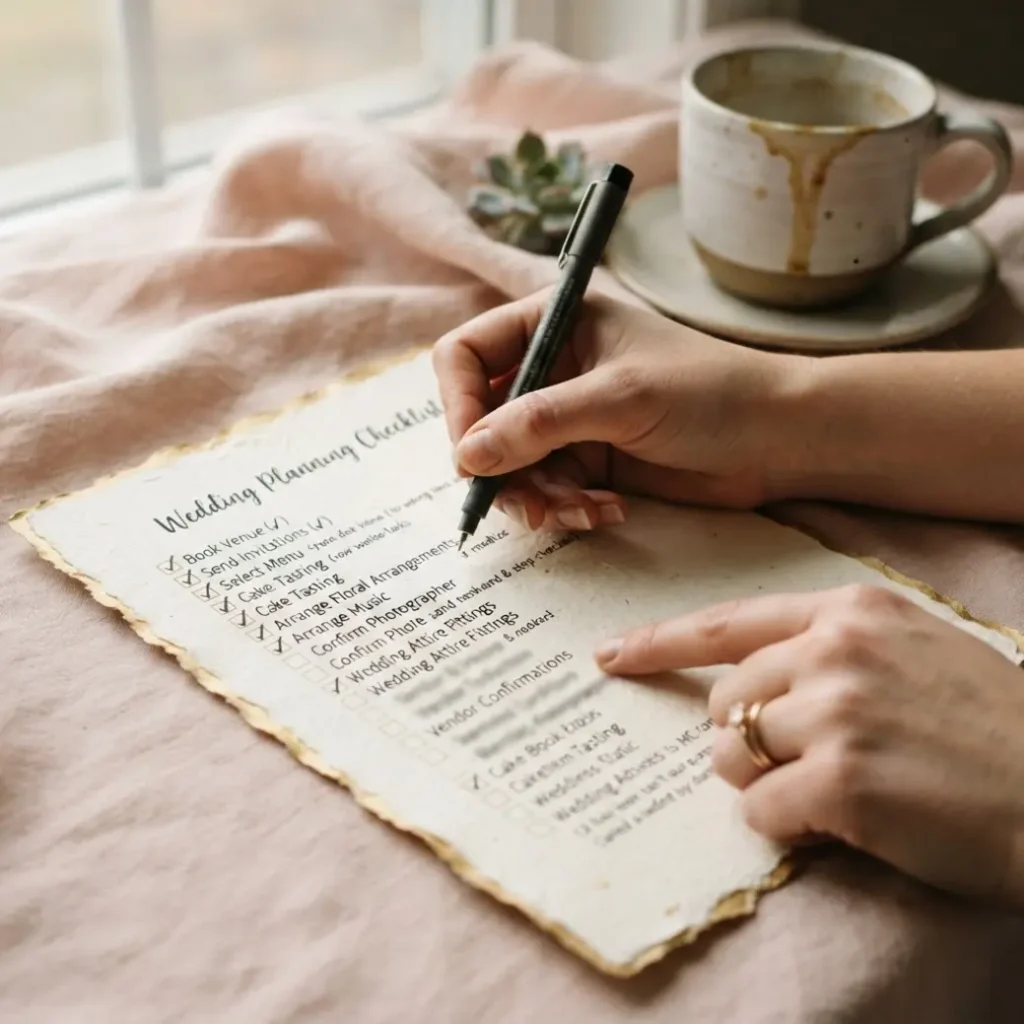
After the venue, the order looks roughly like this as part of your wedding planning checklist, and each step exists because of a real constraint, not tradition:
- Venue. Locks your date; everything else depends on it
- Full-service planner, if you’re hiring one. They need runway to negotiate on your behalf
- Photographer and band/DJ. Both can typically only work one event per night, so popular ones get claimed fast
- Caterer, if separate from your venue. Menu planning and tastings take lead time
- Florist and videographer. Seasonal availability and existing bookings tighten as your date nears
- Rentals, hair and makeup. Flexible later, but confirm counts once your guest list settles
- Cake and stationery. Last, since these depend on nearly everything else being final
Industry planning guides consistently make the same point about photographers and bands specifically: they can typically only work one event per night, which is exactly why they belong near the top of any real wedding planning checklist instead of buried in month six. (BridalGuide)
His Take: Lock the venue date before you fall in love with anything else. We watched three separate friends fall for a florist or a band, only to find out the date they wanted was already gone. The date is the one domino that knocks over every other decision.
When should I actually book each critical vendor?
Most couples plan for 12 to 15 months, and within that window, specific vendors need to be locked at specific points — venues 12 to 18 months out, photographers 10 to 14 months out, per the WeddingWire vendor booking timeline guidance widely used across 2025-2026 planning content.
| Vendor | Recommended booking window | Why this timing |
|---|---|---|
| Venue | 12-18 months | Availability, exclusivity on your date |
| Full-service planner | 12-18 months | Needs runway to work on your behalf |
| Photographer | 10-14 months (top pros: 12-18) | One event per night, books out fast |
| Caterer | 9-12 months | Menu, tastings, staffing lead time |
| Videographer | 8-12 months | Same single-event constraint as photo |
| Florist | 8-10 months | Seasonal sourcing, existing bookings |
| DJ/Band | 8-12 months | One event per night |
| Hair & makeup | 4-8 months | More flexible, but confirm early |
We have to be straight with you here: none of the sources behind these numbers. The Knot, WeddingWire, or the planning guides built on their data. Publish an actual median lead time in days, or the percentage of couples who booked earlier or later than this window. Those specific stats don’t exist in public 2025-2026 data. What we can tell you, because multiple planning guides agree on it, is a practical adjustment: add two to three months to every window above if you’re marrying on a peak-season Saturday (May through October) in a major metro.
If you’re working with less than six months, this is the order to prioritize inside that vendor booking timeline for your wedding planning checklist: venue first if anything is still available, then photographer, then DJ, then caterer or rentals, then hair and makeup last. That’s operational advice based on how availability actually tightens, not a statistic. We’re not aware of hard data on outcomes for compressed timelines, so we won’t pretend otherwise.
What deposit and payment schedule should I expect — and what should I negotiate?
Most vendors ask for a 25 to 50% deposit at booking, with final balances commonly due 7 to 30 days before the wedding, according to wedding vendor payment guides synthesizing 2025-2026 industry norms. That vendor deposit percentage is fairly consistent whether you’re booking a venue, photographer, or florist. Record deposit amounts in your wedding planning checklist.
| Vendor | Typical deposit | Notes |
|---|---|---|
| Venue | 25-50% | Often plus a refundable $500-$2,000 security deposit |
| Photographer/videographer | 25-50% | Balance due 7-30 days before |
| Caterer | 20-30% | Balance often due 7-14 days before |
| Florist | 25-50% | Balance due 14-30 days before |
| DJ/Band | 20-50% | Balance day-of or 14-30 days prior |
| Planner | 25-50% | Higher end for full-service packages |
The standard shape is a three-part schedule: a non-refundable booking retainer at signing, a mid-planning payment (often around 25%), and a final balance 14 to 30 days out. Before you sign anything, ask for a few specific things and note them in your wedding planning checklist:
- A detailed line-item invoice, not a lump-sum total
- Whether the deposit is refundable under any circumstance, in writing
- Explicit triggers for refunds or rescheduling. Not “we’ll figure it out”
- Whether the vendor requires you to carry your own liability insurance
Bestie aside: Keep one running list of every deposit you’ve paid, to whom, and what’s still owed. A shared note, a spreadsheet, whatever. The number of couples who’ve called us at 11pm convinced they double-paid a florist, when really they just lost track across six different vendor portals, is higher than it should be.
Deposits being non-refundable isn’t a scam, exactly. It’s how vendors protect against a date going unbooked. But it does mean the wedding planning checklist step of “pick a vendor” and the step of “sign the contract” should never happen in the same sitting. Read it once, sleep on it, then sign. Our wedding vendor contract guide walks through the clauses worth flagging before any signature goes down.
What cancellation, rescheduling and insurance rules should I watch for?
Deposits are commonly non-refundable, and wedding insurance premiums vary widely by policy and coverage level. We don’t have a single verified 2025-2026 source pinning down a specific price band, so treat any exact number you see quoted elsewhere with a raised eyebrow. What matters more than the ballpark figure: even a modestly priced policy is small compared to what it protects against a canceled venue or a no-show vendor.
Contract mechanics to expect, and to read closely before you sign:
- A non-refundable retainer, regardless of when you cancel
- Tiered cancellation penalties that increase the closer you get to your date
- A separate, usually refundable, security deposit for venues ($500-$2,000)
The Catch: Some venue contracts bury a 20-25% “administrative fee” plus food-and-beverage tax in the fine print, separate from your quoted price — ask for the true final total in writing before you sign, not the number on the tour.
A wedding insurance policy generally covers liability up to $1 million (often the exact number your venue requires anyway) and cancellation triggered by vendor failure or extreme weather. Uptake is described across industry commentary as “relatively low,” but nobody publishes a hard adoption percentage for 2025-2026, so we’re not going to invent one. Just know it’s underused, not unnecessary.
What operational pain points do couples actually report — and how do I prevent them?
Forum threads from 2024 through 2026 on r/weddingplanning show the same complaints surfacing again and again: hidden fees, vendors who go quiet for weeks, and contracts with terms nobody explained out loud. One couple described being hit with over $10,000 in surprise “service” and “sustainability” fees that were technically in the contract’s fine print but never mentioned in their meetings.
These aren’t rare horror stories. They’re patterns. Here’s what shows up most, and the specific step that heads each one off:
- Hidden vendor fees (administrative charges, “venue fees” from outside caterers). Request a full line-item invoice at contract signing, before you pay anything
- Vendor silence. One vendor quoted in a Reddit thread called 48 hours of no response “a pretty large red flag”; build a response-time expectation into your first email
- Contracts routed through a middleman (planner or venue processing vendor payments). Ask directly whether you’re paying vendors yourself or through a third party who could mark it up
- Delivery and setup surprises. Confirm exact setup/teardown windows and any penalty for going over, in writing, before the week of your wedding
We can’t tell you what percentage of couples run into each of these. No source publishes a statistically representative rate, and we’re not going to make one up. What we can tell you is that these four show up over and over, in enough independent threads, that they’re worth building into your wedding planning checklist as standing questions, not afterthoughts.

Can you walk me through a sequenced wedding planning checklist for momentum?
Here’s a milestone-based wedding planning checklist tied to both timing and money, built for a standard 12-15 month runway, with a condensed version if you’re working with less:
- Month 12: Sign venue contract, pay 25-50% deposit, confirm your date is locked
- Month 10: Book photographer and videographer, deposits due at signing
- Month 9: Hire caterer if separate from venue, book florist
- Month 8: Book DJ or band, confirm officiant
- Month 6: Attend tastings, finalize rentals, pay mid-stage vendor charges
- Month 4: Book hair and makeup, order invitations
- Month 1: Finalize day-of timeline, confirm every remaining balance is paid
Once every vendor’s booked, our wedding day timeline template shows exactly how those pieces fit into the day itself.
If you’re behind — engaged eight months ago and just now opening a checklist app. The recovery order is: venue and date first, photographer second, caterer third. Everything else can compress. If money’s tight because of that compression, reallocate using The Knot’s category percentages above; cutting florals from 9% to 5% of your budget buys real room without touching venue or catering.
We’ll flag it one more time because it matters: nobody publishes the precise median day-count for when couples actually book each vendor, or what share book early versus late. Anyone giving you that number without a citation is estimating. What we’ve given you instead is the sequence and the checkpoints that determine whether you’re on track. Which, for a wedding planning checklist, is the part that actually keeps you moving.
Bringing the checklist and the money together
The anxiety at the center of all this was never really about how much there is to do. It’s about not knowing which task, if you get the order wrong, turns into a missed deposit deadline or a vendor who’s suddenly unavailable. That’s the exact gap we kept running into with our own couples and our own wedding — tasks and money living in two different places, so nobody could see both at once. A real wedding planning checklist has to hold your sequence and your payment schedule side by side, or it’s just a to-do list with extra guilt attached.
That’s what we built the Big Day Wedding Planner to fix. Budget, vendor manager, and timeline in one place, so the “did I already pay this deposit” panic has an actual answer instead of a guess, and so your wedding planning checklist stays with the payments. It’s a one-time purchase, works offline, and doesn’t care what time zone either of you is in when you open it.
Keep every vendor, deposit, and deadline in the order that actually matters. The Classic Wedding Planner does the sequencing for you.
Frequently Asked Questions
How much does the average U.S. wedding cost in 2025?
The average U.S. wedding cost $34,200 in 2025, according to The Knot’s 2026 Real Weddings Study, which surveyed over 10,000 couples. That figure works out to roughly $292 per guest, and it’s the baseline any realistic wedding planning checklist should budget against.
What percent of my budget typically goes to venue and catering?
Venue and rentals take up about 29% of the average wedding budget, and catering, cake, and drinks take another 24%, per The Knot. Together, that’s more than half of a typical $34,200 budget before you’ve booked a single other vendor. Include those shares in your wedding planning checklist.
When should I book my venue and photographer?
Book your venue 12 to 18 months out, and your photographer 10 to 14 months out (top photographers may require 12 to 18 months), per widely-used wedding vendor booking timeline guidance. Both should sit near the top of your wedding planning checklist since both lock in availability tied to your exact date.
What deposit percentage should I expect to pay at booking?
Most vendors ask for a 25 to 50% deposit at signing, whether that’s a venue, photographer, florist, or DJ. Some venues also add a separate, usually refundable, security deposit of $500 to $2,000 on top of that.
Should I buy wedding insurance, and how much does it cost?
Coverage commonly includes liability up to $1 million and cancellation protection for vendor failure or extreme weather. We don’t have a single verified 2025-2026 source for a specific price range, so we’re not going to hand you a number we can’t back up — get a quote directly from a named insurer for your actual policy terms. Industry sources describe uptake as low, though no reliable adoption percentage is published for 2025-2026 either.