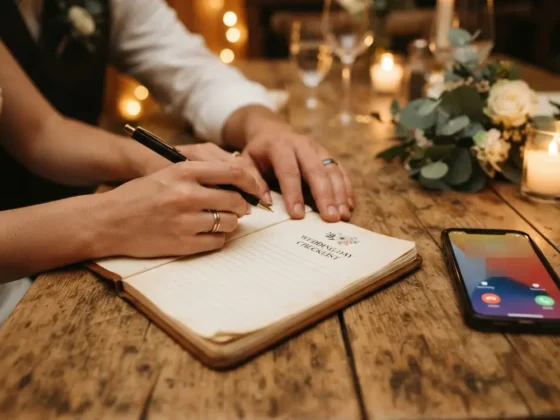
Your wedding countdown app just flipped from weeks to days, and you’re refreshing a blank hour-by-hour wedding day timeline template at midnight, sure a template will fix it. It won’t, not by itself, because the schedule was never the hard part.
We learned that building a wedding day timeline template for our own wedding while working out of two suitcases in three different countries that year. But the moment that actually taught us something wasn’t ours. It was a friend’s wedding outside Austin, where the shuttle company sent one van instead of the three they’d confirmed, so half her guest list was still standing in a hotel lobby when the ceremony was supposed to start. The processional got pushed twenty-two minutes. Nobody had written down who was supposed to notice.
Therefore this post isn’t another “cocktail hour is one hour” listicle. It’s the wedding day timeline template for what happens between the blocks.
- Don’t build your day around one dramatic ceremony-length number — build it around who’s actually watching the fifteen minutes between blocks. That’s where weddings go sideways, not the ceremony itself.
- Cocktail hour is already doing double duty as your photo buffer. On-site ceremonies need maybe 30-45 extra minutes; if you’re driving somewhere new, budget 45-90, especially with a shuttle involved.
- Get the vendor’s overtime rate and their exact clock definition of “event end” in writing before you sign. That’s the fine print quietly deciding what your day actually costs.
What is a realistic overall wedding-day length I should plan for?
Plan for a ceremony of 15 to 30 minutes if it’s secular, a 1-hour cocktail hour, and a reception running 4 to 5 hours, sometimes stretching to 7 depending on how dinner service and dancing are structured. That’s the anchor every major guide agrees on for a wedding day timeline template, per The Knot.
Religious ceremonies run longer, sometimes closer to an hour, which shifts everything downstream. Here’s how that translates into an actual block schedule for a wedding day timeline template if your ceremony starts at 3:00 pm:
| Block | Typical length | Clock time (example) |
|---|---|---|
| Ceremony | 15–30 min (secular) | 3:00–3:30 pm |
| Cocktail hour | ~1 hour | 3:30–4:30 pm |
| Reception | 4–5 hours | 4:30–9:30 pm |
Shorten this for micro weddings under 50 guests, where a 1 to 2 hour reception genuinely covers dinner and toasts without anyone feeling rushed. A compact wedding day timeline template handles that.
Religious ceremonies run longer, sometimes closer to an hour, which shifts everything downstream. Here’s how that translates into an actual block schedule if your ceremony starts at 3:00 pm:
| Block | Typical length | Clock time (example) |
|---|---|---|
| Ceremony | 15–30 min (secular) | 3:00–3:30 pm |
| Cocktail hour | ~1 hour | 3:30–4:30 pm |
| Reception | 4–5 hours | 4:30–9:30 pm |
Shorten this for micro weddings under 50 guests, where a 1 to 2 hour reception genuinely covers dinner and toasts without anyone feeling rushed. A compact wedding day timeline template handles that.
Do I need a day-of or month-of coordinator, and what will that realistically cost?
Expect to pay somewhere around $2,100 on average according to The Knot, or closer to $4,047 if you’re looking at broader planning services, per Zola. Those two numbers sit far apart because they’re measuring different service tiers, and neither source breaks out day-of versus month-of versus full-service by region, which is a real gap in the data right now.
What we can tell you from having run our own multi-country wedding without one: the day-of coordinator cost question isn’t really about the dollar amount. It’s about whether anyone besides you is holding the wedding day timeline template when the florist and the DJ show up at the same fifteen-minute window.
Ask yourself these before deciding:
- Is your venue handling multiple vendor load-ins with no on-site venue manager?
- Are there religious or cultural timing requirements a stranger vendor won’t know to protect?
- Will your family or wedding party be traveling between two or more sites that day?
- Is there a person in your life who would actually enjoy running point, or would it just add another job to someone already in the wedding party?
Having a coordinator on-site allows you to enjoy your day, knowing that a professional handles all the logistics in the background — a day-of coordinator is worth their weight in gold!
Nora Sheils, Rock Paper Coin / Bridal Bliss
Bestie aside: If you can’t be on-site running cues yourself, pay for a pro who can hold the wedding day timeline template. The averages suggest it’s a small slice of your total budget, and it removes the single biggest day-of risk.
Before you sign anything, get these line-items confirmed in writing: overtime rate per hour, who’s the single point-person for vendor questions and the wedding day timeline template during the day, and whether the coordinator carries their own liability insurance. Supplied research didn’t verify insurance or permit norms for coordinators, so that part’s on you to ask directly. If the coordinator fee is stretching your numbers, our average wedding cost breakdown shows where else that budget usually goes.
How much buffer should I build between ceremony, photos, and reception?
Cocktail hour is the buffer most weddings already have built in, and at roughly one hour it’s usually enough to cover family photos while guests are seated and served their first drink, per WeddingWire and The Knot. Make sure that’s reflected on your wedding day timeline template.
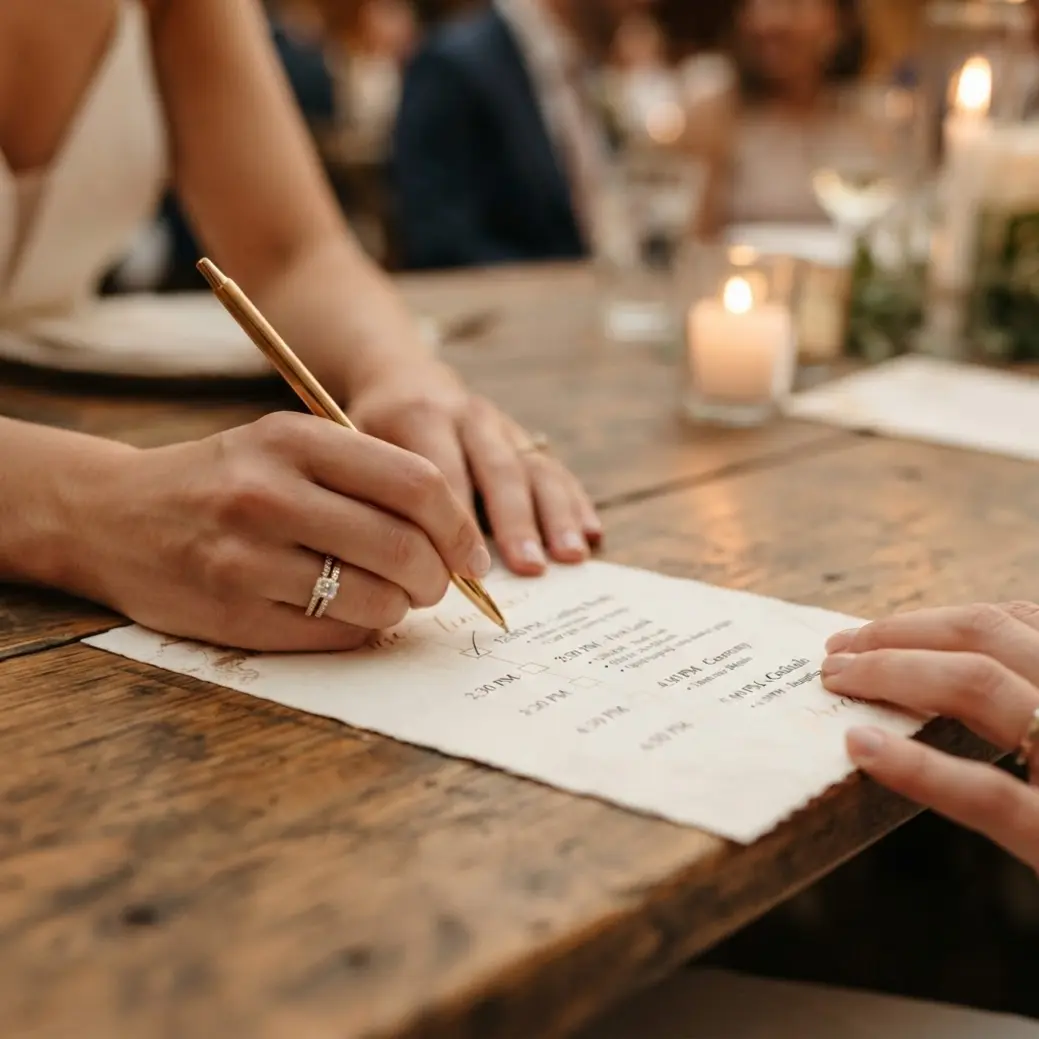
On-site ceremonies, where the reception happens at the same venue, generally need only 30 to 45 minutes of dedicated wedding day timeline template buffer time between ceremony and reception for family photos before cocktail hour absorbs the rest. Off-site transitions, where guests and the wedding party are driving somewhere new, need 45 to 90 minutes or more, especially if there’s a shuttle involved. Which, if you’re wondering why we keep circling back to shuttles: that’s the exact link that broke at our friend’s wedding, and it’s rarely the ceremony itself that runs long. It’s the fifteen minutes nobody assigned to anyone.
Add more buffer if you’re doing a religious ceremony that can run close to an hour, if the photographer has a long list of family combinations to get through, or if the wedding party is splitting across two locations. The supplied research doesn’t give us vendor-specific buffer minimums, so confirm directly with your photographer and venue coordinator what they’d actually recommend for your group size.
What are the vendor overtime norms and extra-fee triggers I should expect?
Vendors typically price around the same baseline the guides use: roughly a 30-minute ceremony, 1-hour cocktail hour, and 4-hour reception, adding up to about a 6-hour event span, per WeddingWire. Anything past that baseline is where overtime fees tend to start, so note those limits in your wedding day timeline template, though the exact dollar figures aren’t public in any consistent way.
Here’s the honest gap: we do not have verified 2025-2026 overtime dollar amounts by vendor type or region. Every “average overtime fee is $X per hour” claim you’ll see floating around the internet is either outdated, regional, or made up. Funny how the one number every couple actually wants is the one nobody publishes.
What you can control regardless: get these specifics in every vendor contract before you sign.
- The exact clock-time definition of “event end” for your wedding day timeline template, not just “reception ends”
- The hourly overtime rate and the minimum billable overtime block (some vendors bill in 30-minute increments, some in full hours)
- Who’s financially responsible if the venue itself runs over, not just the vendor
- Whether setup and breakdown windows are billed separately from the event hours
As a placeholder, it’s reasonable practice to build a small overtime buffer into your budget even if you never use it, though we want to flag that this recommendation isn’t backed by a specific verified figure in the current research; treat it as prudent, not proven.
What day-of problems do couples actually report, and which ones are we missing hard data on?
Ceremony length is the variable that quietly reshapes the whole day: secular ceremonies run about 15 to 30 minutes while religious ceremonies can stretch past an hour, per The Knot. A schedule built around the shorter number falls apart fast if yours runs the longer one. It’s the same miscalculation that trips people up with the vow-writing timing mistake to avoid — the vows themselves need a slot on the clock too, not just the ceremony around them.
We’ll be straight with you: the tier-1 sources we pulled for this post don’t include forum threads, Facebook group vents, or review-site complaint counts, so we can’t hand you a stat like “43% of couples report a vendor no-show.” That data doesn’t exist in verified form yet. What we can tell you, from sitting through enough of these calls ourselves, is which problems show up constantly in practice, even without a citation attached:
- A vendor arrives late because the previous event on their calendar ran long
- Nobody confirmed a secondary contact number for the day, so one missed call stalls everything
- The getting-ready photos run long because hair and makeup started behind schedule
- Family photo lists balloon in real time because someone’s cousin “just got here”
- Transportation shows up at the wrong entrance or with the wrong headcount
His Take: Start with the photographer’s must-have shot list and work backward from there. It exposes your single biggest timing risk faster than staring at a blank schedule ever will.
The mitigation playbook is mostly boring, on purpose: written vendor call-times, a second emergency contact for each vendor, a transportation reconfirmation two days out, and a staged family photo list in the wedding day timeline template handed to whoever’s running point. None of that requires a coordinator’s certification. It just requires someone to have written it down. If you want to see what vendors themselves tend to bury in the fine print, our the clauses worth flagging before you sign walks through the clauses worth flagging before you sign.
Can you give minute-by-minute timeline templates and sample day-of schedules right now?
Honestly, not responsibly, not yet. The tier-1 research behind this post supports the phase-length anchors, ceremony, cocktail hour, reception, but it doesn’t include the 6 to 8 fully sourced, minute-by-minute schedules with vendor arrival windows that would make a real wedding day timeline template instead of a rough sketch.
What we’d need before publishing those: verified vendor arrival and departure windows by category, per-vendor buffer recommendations, overtime dollar triggers, and photographer shot lists with realistic time estimates attached. Until those exist in citable form, here’s the honest skeleton we can back with the data we have, sized for a micro wedding under 50 guests:
| Time | Block |
|---|---|
| 4:00 pm | Ceremony (15–30 min) |
| 4:30 pm | Buffer / photos |
| 5:00 pm | Reception begins (1–2 hours) |
If you’re mid-panic staring at a blank calendar right now, this is exactly the gap a free wedding checklist is built for, not to hand you a fake minute-by-minute schedule, but to keep the phases in order so you’re not guessing what comes next at 11 pm. It can also help you draft a simple wedding day timeline template to get started.
What exact research gaps must be filled before this pillar is fully evidence-backed?
The Knot’s 2026 Real Weddings Study surveyed 10,474 U.S. couples married in 2025, which gives us solid category averages, but several vendor- and region-specific tables simply aren’t public yet, per The Knot. We’d rather tell you that plainly than pretend a stat exists because it would look good in a listicle.
Here’s what’s still missing before we’d call this topic fully evidence-backed:
- Verified percentages of couples hiring day-of versus month-of coordinators, broken out by region
- Full-day versus day-of coordination cost ranges with real sample sizes behind them
- Vendor overtime trigger language and typical dollar figures by vendor type and region
- Representative forum quotes and frequency counts for day-of complaints from 2024 through 2026
- Named expert case studies and real contingency costs for weather, power outages, or vendor cancellations
- Verified tipping norms and whether venues require insurance or permit proof to be shown day-of
Filling those gaps means vendor association surveys, review-forum data pulls, and interviews with planners across several regions, not another rewrite of the same five-hour reception stat. We’ll flag it here rather than dress up a guess as a fact.

Bringing it back to your actual day
Every part of this comes down to the same feeling: the fear that nobody’s watching the fifteen minutes between blocks, the way nobody was watching it for our friend outside Austin when that shuttle didn’t show. A wedding day timeline template only works if someone’s actually holding it on the day, cross-checking arrivals against the sheet in real time.
That’s the exact gap the Big Day Wedding Planner app was built to close, letting you build your wedding day timeline template, vendor timeline, guest list, and day-of contacts in one offline place so the person running your day isn’t reconstructing it from a group text at 7 am.
If you want to see how that fifteen-minute gap actually breaks down in a real bridal party, our wedding day mistakes guide walks through it.
Want someone actually holding the timeline on the day? The Classic Wedding Planner keeps your schedule, vendor contacts, and buffers in one offline place.
Frequently Asked Questions
How long is a typical wedding reception?
Most tier-1 wedding guides put it at 5 to 7 hours, with Zola citing that range and The Knot describing about 5 hours as standard, including 1 hour for cocktails and roughly 4 hours for dinner and dancing.
How long is a typical ceremony?
Secular ceremonies typically run 15 to 30 minutes, while religious ceremonies can run close to an hour or more, according to The Knot. That difference alone should shift how you build your wedding day timeline template.
What do wedding planners cost on average?
The Knot reports an average planner cost of $2,100, while Zola’s broader planning-services average lands at $4,047. The gap likely reflects different service tiers, though neither source breaks that out explicitly.
What sample size does The Knot’s 2026 report use?
The Knot’s 2026 Real Weddings Study surveyed 10,474 U.S. couples who married in 2025, giving solid category averages for cost and planning data.
Which timeline anchors can I actually rely on right now?
You can build around a ceremony of 15 to 30 minutes for secular ceremonies, a 1-hour cocktail hour, and a 4 to 5 hour reception. These three anchors are consistent across The Knot, WeddingWire, and Zola.
Are there verified statistics on how many couples hire day-of coordinators?
Not in the current tier-1 research. This is a genuine data gap, no verified 2025-2026 figure exists for coordinator hiring rates by region, so treat any specific percentage you see elsewhere with real skepticism until it’s sourced.