Your wedding-day countdown notification just fired (six days out) and you’re staring at a timeline that still has a three-hour gap where “SFX makeup and costume stuff” was supposed to live. The common belief is that a halloween wedding basically plans itself: spooky vibe, fall palette, done. But October 31 has more moving parts per hour than almost any other wedding date on the calendar, and most of them are invisible until the week you actually need them.
We know this because a friend of ours (a genuinely organized person who color-codes spreadsheets for fun) nearly watched her Austin wedding implode when her theatrical-makeup artist and her AV team both showed up expecting to share the same two-hour load-in window. Nobody had put it in writing. Her venue coordinator had assumed each vendor “knew the drill.” The fog machine operator had not been told there was a fire-safety walkthrough required. By 4pm she was troubleshooting permits on her phone in her wedding dress, which is exactly the kind of sentence you should never have to live.
That specific disaster (permits, timing collisions, vendor assumptions left unconfirmed in writing) is what this guide is actually about. Not the halloween wedding ideas on every mood board. The logistics.
How common are October/Halloween weddings, and what attendance patterns should you expect?
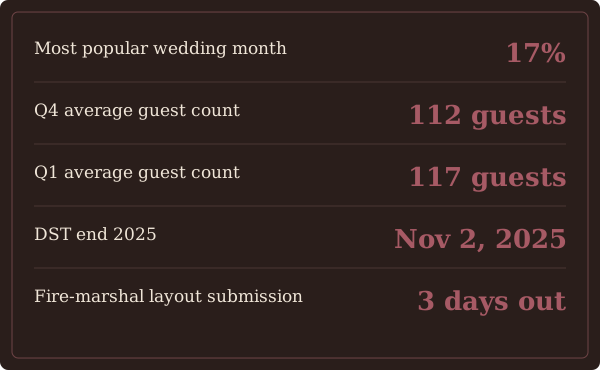
October is the single most popular wedding month in the United States. The Knot’s 2025 study found that 17% of weddings took place in October: more than any other month. That said, no 2025 or 2026 industry report breaks out attendance figures specifically for October 31 or Halloween-date weddings. Any number you’ve seen quoted for “Halloween wedding no-show rates” is not sourced from verified data.
What The Knot’s published guest-count data does show: weddings held from October through December averaged 112 guests, compared with 117 for Q1 weddings. That five-guest gap isn’t dramatic, but it suggests a small Q4 softening: possibly competing holiday plans, travel costs, or early fall fatigue after a packed wedding season.
Because no verified Halloween-specific RSVP or no-show rate exists, the practical move is to build your own data layer. Start tracking RSVPs as “confirmed,” “likely,” and “possible” in a spreadsheet the moment invites go out. Set your RSVP deadline no later than five weeks before the date: October 31 guests often need to make childcare arrangements for trick-or-treating with kids, which is a real conflict nobody mentions in the inspiration posts. Follow up with every non-responder by week three.
For catering contracts, build in a guaranteed-minimum clause. Ask your caterer to lock the final count at RSVP deadline plus three business days, and require that any overage above that count is billed at the per-head rate, not a flat penalty. This protects you if last-minute declines hit after the kitchen has already ordered. A structured guest list template that tracks RSVP status in real time is the fastest way to stay on top of those moving numbers in the final weeks.
How much extra will a Halloween wedding actually cost, and where should you ask for itemized pricing?
Here’s the honest answer: nobody knows, and anyone quoting you a national average Halloween premium is making it up. No 2025 or 2026 industry report (not The Knot, not Zola, not WeddingWire) publishes a verified surcharge figure for October 31 weddings. A WeddingWire venue-pricing document lists fog machines and cold sparks as special-effects line items, but stops short of naming a price range. Which means your actual cost depends entirely on what your specific vendors decide to charge, and whether you ask for it in writing before you sign anything.
Planning a halloween wedding with specialty effects means you’re stacking line items that normal weddings don’t carry. Request an itemized quote for every single one of these from every vendor you’re considering:
- Venue base rental rate and any date-specific demand premium
- Overtime hourly rate (and the exact clock-time that triggers it)
- Event cleanup fee and any post-event surcharge for SFX residue
- SFX equipment rental and operator labor (separate line items)
- Fog or smoke machine setup and hourly runtime cost
- Lighting rigging, programming, and technician hours
- SFX theatrical makeup application and touchup station fee
- Costume or styling fee, if applicable
- Security staffing, if the venue requires it for late-night or open-flame events
When you send your quote request, include this templated email paragraph so every vendor answers the same questions:
“Please provide a fully itemized quote that breaks out: (1) base service fee, (2) equipment rental, (3) labor/operator hours, (4) setup and strike time, (5) overtime rate and trigger time, (6) any date-premium or demand surcharge for October 31, (7) permit fees you will pull and pass through, and (8) any cleanup charges. Please confirm which permits your quote includes and which are my responsibility to obtain.”
Once you have quotes back, add these clauses to the contract before signing: a capped overtime ceiling (dollar amount, not just hourly rate), the exact make and model of any SFX equipment, operator certification requirements, vendor responsibility for pulling their own permits, and a force-majeure clause specifically referencing municipal event restrictions, because a city can cancel a permit after you’ve signed a vendor contract, and you need a clean exit if that happens.
Bestie aside: If a venue tells you “we handle all the permits,” write back and ask them to put the specific permits, the responsible party’s name, and a dollar cap on any associated fees into the contract exhibit. “We handle it” is not a contract term. The sentence that saves you is: “Please list each permit by name and confirm in writing that associated fees are included in the quoted price.”
What should your minute-by-minute day-of timeline include for makeup/SFX, costume changes, ceremony timing vs sunset, and vendor buffers?
Daylight Saving Time ends on November 1 in 2026, so October 31 falls before the clock change (it also did in 2025, when DST ended November 2). Your ceremony happens in standard fall light, with sunset arriving earlier than most couples expect. No 2025 or 2026 industry report supplies verified Halloween-specific timing standards; the templates below are editorial planner recommendations, not sourced statistics. Use them as a starting framework and plug in your city’s actual sunset time (timeanddate.com is the fastest tool for this).
Outdoor ceremony template (sunset-sensitive): editorial recommendation:
| Time Before Ceremony | What’s Happening |
|---|---|
| T-5 to T-4 hours | SFX theatrical makeup begins (allow 60–120 min per person for complex looks; stagger artists if multiple people need SFX) |
| T-4 to T-3 hours | Standard hair and makeup (45–75 min); SFX touchup artist sets up station |
| T-2.5 hours | Lighting/AV and fog-machine operators begin load-in and rigging |
| T-1.5 hours | Vendor SFX run-through; confirm fog clearance, lighting cues, cold sparks placement |
| T-60 min | Wedding party dressed; final SFX touchups; first-look photos (use remaining natural light) |
| T-30 to T-0 min | Ceremony: timed 30–60 minutes before local sunset for golden-hour ceremony and portraits |
| Sunset | Reception lighting cues activated; cocktail hour transitions to reception space |
| Post-ceremony | Couple portrait session while guests in cocktail hour (60 min) |
| Strike window | No earlier than agreed finish time plus 60–120 min buffer; confirm in contract |
Indoor ceremony template: editorial recommendation:
| Time Before Ceremony | What’s Happening |
|---|---|
| T-4 to T-3 hours | SFX makeup stations staggered (avoid bottleneck: no more than two complex looks running simultaneously) |
| T-3 to T-2 hours | Standard hair and makeup; AV/lighting team programs cue sheet with venue coordinator |
| T-2 hours | Fog and lighting run-through; fire-safety walkthrough if effects are in use |
| T-90 min | Wedding party dressed; SFX touchup station staffed through end of cocktail hour |
| T-60 min | Portraits begin (indoor lighting plan confirmed with AV team) |
| Between portraits and reception | Costume changes scheduled here: allow 30–45 min per major change, not during dinner |
| Reception | AV lighting cues on programmed schedule; touchup artist available for photos |
Require vendor load-in windows of 2–4 hours before guest arrival for any lighting, fog, or AV setup. Build a 60-minute buffer between your last confirmed guest arrival and any pyrotechnics or cold-sparks activation: crowds and effects need a confirmed clearance distance, not an estimated one. Ask every SFX vendor to provide a written operations run sheet before the wedding day.
His Take: Couples fight over whether to do the dramatic late-night fog-and-cold-sparks moment or use that budget on a proper golden-hour photo window. My vote is always the photo window. Effects look incredible in person and mediocre in photos unless you have a photographer who specifically works with SFX lighting. The golden-hour portraits exist forever. The fog dissipates in about four minutes.
What permits, safety checks and contract clauses must you confirm for fog machines, open flames, pyrotechnics, confetti and theatrical makeup?
Local fire marshals have hard requirements for the effects that show up at most halloween wedding receptions. The Howard County, MD Office of the Fire Marshal is one published example: pyrotechnics and open-flame devices require permits and approvals before use in any assembly occupancy. Fire extinguishers are required too (the county specifies a minimum 2-A:10-BC rating for event tents). Event layout drawings must be submitted to the fire-rescue authority no later than three days before the event. Your county may have different timelines: check with your local authority, not your venue coordinator, who is not the permitting office.
Use this checklist with your venue and local fire marshal before the wedding week:
- Pyrotechnics or cold-sparks permit: confirmed yes/no, permit number on file
- Open-flame approval: confirmed in writing for any candles, fire elements, or torches
- Fire extinguisher confirmation: location, charge status, and responsible party named
- Fog or smoke machine notification: confirm whether your venue or local authority requires a Safety Data Sheet (SDS) for the fluid used
- Event layout submitted to fire-rescue authority (minimum three days before event)
- Venue’s internal policy on confetti, air cannons, and cold sparks: in writing, not verbal
- Noise ordinance and event curfew: confirmed with venue and local municipal authority
- Parking and neighborhood coordination: confirm street permit if guests will use public parking during trick-or-treating hours
For every SFX vendor, add this clause (or a close equivalent reviewed by your own attorney) to the contract before signing:
“Vendor shall maintain commercial general liability insurance with limits no less than those required by the venue (to be confirmed in writing by venue and attached as Exhibit A). Vendor shall name [Couple Names] and [Venue Name] as additional insureds on its policy. Vendor is solely responsible for obtaining all permits required for pyrotechnics, open flame, fog/smoke machines, and any special effects included in this agreement, and shall provide copies of all permits to [Couple Names] no later than seven (7) days before the event date.”
No universal liability dollar amount applies to every venue: ask yours what minimum coverage it requires, get it in writing, and attach it as a contract exhibit. An additional-insured endorsement is non-negotiable: it means their policy covers an incident at your event, not just incidents at theirs.
One operational note that is easy to overlook: assign a named point of contact on your run sheet for emergency shut-off. If something goes wrong with the fog machine mid-reception, the answer cannot be “find whoever set it up.” That person’s name, phone number, and their physical location during the event goes on the run sheet before the day starts.

Your October 31 run sheet, contract, and permit checklist: all in one place
The gap between a halloween wedding that runs clean and one that doesn’t isn’t the aesthetic. It’s whether the SFX operator has the permit in hand on Thursday, whether the load-in windows are in every vendor contract, and whether someone has actually looked up the local sunset time and put it in the timeline. Those are checkable, closeable items, not vibes decisions.
By the end of this post you should be able to send the itemized SFX questionnaire to every vendor on your list, plug your city’s sunset time into the outdoor timeline template, and drop the three contract clauses (overtime cap, operator certification, and additional-insured endorsement) into your agreements before you sign. If you want those timelines, vendor questionnaire, and permit checklist living in one place you can actually edit and share with your coordinator, the BigDay Classic Edition is built for exactly this: a run sheet you can hand off, not a spreadsheet you’re texting screenshots of at midnight. The day-of friction is real, and the logistics are the part no inspiration post will save you from.
If you’re still sorting through the guest list side of things (plus-one decisions, RSVP tracking, the works) our piece on who gets a plus one covers the decisions that tend to blow up in the final weeks, and our day-after brunch guide is worth a read if you’re extending the weekend for out-of-town guests who made the trip for your October 31 date.
Frequently Asked Questions
Are there published industry statistics for weddings specifically held on October 31?
No. The 2025 and 2026 industry reports we reviewed (including The Knot’s 2025 study and Zola’s 2025 First Look report (which surveyed nearly 6,000 couples)) do not break out wedding data specifically for October 31 or Halloween-date weddings. The Knot reports October as the most popular wedding month overall at 17%, but that figure covers the full month, not the 31st specifically. Any percentage you’ve seen quoted for “Halloween wedding frequency” is not drawn from a verified industry source.
When does Daylight Saving Time end in 2026 and 2027, and does it affect an October 31 wedding?
Daylight Saving Time ends on November 1, 2026 and November 7, 2027. Both dates fall after October 31, which means couples marrying on Halloween in either year are working with pre-clock-change sunset times. In practical terms, sunset arrives earlier than summer or early fall, and later than you’d get in November. Look up your specific city’s October 31 sunset time on timeanddate.com and build your ceremony timing around that actual number, not a general “it gets dark early” assumption.
What permits or fire-marshal rules should I expect if I plan to use pyrotechnics, open flame or fog machines at my wedding?
Requirements vary by jurisdiction, but the pattern is consistent. As one example, the Howard County, MD Office of the Fire Marshal requires permits for pyrotechnics and prohibits open-flame devices in assembly occupancies unless the Fire Marshal permits them. Extinguishers are required (a minimum 2-A:10-BC rating for event tents), and event layout drawings must be submitted at least three days before the event. Your local fire marshal may have different lead times or additional requirements. Call the authority directly (not your venue) to confirm what applies to your specific effects and venue type, and get the permit numbers in writing before the week of your wedding.