You’re three tabs deep into a planning checklist at 9pm on a Tuesday, and the thing nobody told you is that how to plan a small wedding has basically no reliable sequencing advice: just the same generic 12-month countdown built for 150 guests and a ballroom.
The assumption is that fewer guests means a simpler version of a big wedding. It doesn’t. Fixed costs don’t shrink with your guest list, vendor minimums don’t negotiate themselves, and the order you do things in matters more when you have less buffer to recover from a misstep.
A friend of ours got engaged in early March and immediately started building what she called “the master spreadsheet.” By April she had seventeen tabs and had done approximately none of the three things that actually needed to happen first. She was coordinating across two time zones (her family on the East Coast, her fiancé’s in the Pacific Northwest) and the late-night calls she kept getting weren’t about whether the venue was beautiful. They were about whether she’d emailed the venue yet. The answer, for six weeks, was no. Not because she was disorganized, but because every checklist she found told her to finalize her color palette before it told her to ask a single venue about a food and beverage minimum.
The sequence is the thing. And that’s what most guides skip.
How much will a small (5–50 guest) wedding actually cost?
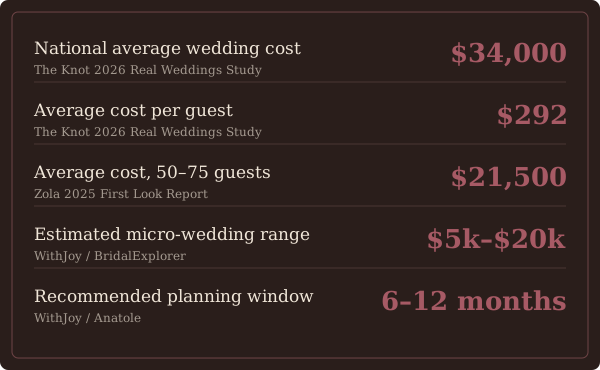
A 5–50 guest wedding typically costs somewhere between $5,000 and $20,000, according to secondary planning guides from WithJoy and BridalExplorer, but those are planning estimates, not verified national survey figures. The Knot’s 2025 national average of $34,000 and $292 per guest reflects all wedding sizes, not specifically micro events.
That $292 number is worth pausing on. Applied to 30 guests, it suggests a $8,760 budget. What it doesn’t account for is that venue rental fees, photographer minimums, and catering packages often carry a fixed floor that doesn’t move when your guest count drops. As Pix.wedding notes, fixed costs can actually make a small wedding more expensive per head than a large one, not less.
Here’s a sample 40-guest budget model using secondary estimates from BridalExplorer. These are planning estimates, not verified national averages: treat them as a starting framework, not a quote:
| Category | Estimated Range (Editor Model) |
|---|---|
| Venue rental | $2,000–$5,000 |
| Catering | $4,800–$7,200 |
| Photography | $2,000–$3,500 |
| Florals | $800–$2,000 |
| Attire, rings, beauty | $2,000–$4,000 |
| Stationery, music, officiant, license | $800–$1,800 |
| Total estimate | $12,400–$23,500 |
To build a working number that’s actually yours, you need four pieces of real information before you budget anything else:
- Ask every venue for their flat rental fee and their food and beverage minimum: both, separately.
- Get a photography package price and ask specifically about overtime rates and a digital-delivery-only option.
- Estimate permits and liability insurance; ask the venue whether they require you to carry your own or whether theirs covers events.
- Separate fixed costs (venue, photographer minimum) from variable ones (catering per-head, florals) so you can actually see where guest count moves the number.
If you want a place to track all of this without building your seventeenth spreadsheet tab, the free budget tracker is a good starting point while you’re still gathering quotes.
How do vendor minimums and micro-packages work: what should you ask and say to negotiate?
Multiple micro-wedding guides consistently flag that venue, catering, and photography pricing often includes fixed minimums or package fees, which means dropping from 150 guests to 30 does not proportionally drop your bill. Reducing your headcount is not the same as reducing your vendor cost. This is one of the most practical realities of figuring out how to plan a small wedding, and it’s the part most checklists gloss over entirely.
A note on what we don’t know yet: the research available as of this writing did not surface verified 2025–2026 named minimum amounts from specific caterers, photographers, or venues by name. What follows is an editorial model: tested framing, not a verified dataset. Before you take any of these numbers to a vendor conversation, get a written quote.
Three categories almost always carry minimums or fixed packages:
- Venues: rental fee plus a food and beverage minimum, often set regardless of guest count. Ask whether the F&B minimum can be met with a reduced menu rather than a higher per-head price.
- Caterers: secondary guides estimate roughly $40 per person for buffet service and up to $150 for plated service, but staffing costs and setup fees often apply regardless of headcount.
- Photographers: most carry a minimum booking fee covering a set number of hours; secondary estimates put micro-wedding photography packages between $1,500 and $4,000.
Two scripts you can adapt (these are BigDay editorial templates, not sourced quotes):
For a venue with a high F&B minimum: “We’re planning a 30-person dinner and our budget for food and beverage is [X]. Can we meet the minimum with a reduced course menu, or is there a buyout option for the space? We’d also want to understand whether we can bring a licensed outside caterer.”
For a photographer: “We’re hosting 25 guests and the event will run roughly four hours. Do you offer a micro-package with digital delivery only, no prints or albums? And what’s your overtime rate if we run long?”
In both cases: get every fee (travel, overtime, setup, gratuity) listed in writing in the contract before you sign anything.
Bestie aside: If the minimum won’t budge, don’t fight the number: massage the menu down to a limited course or reduce the booked hours instead. You’re not losing the negotiation; you’re just moving the lever they’ll actually let you touch.
What timeline and day‑of schedule should you use for a micro wedding?
For a 5–50 guest wedding, planning guides recommend starting 6–12 months out, with the earliest months reserved for three decisions: venue, photographer, and guest list. WithJoy’s micro-wedding guide suggests 6–12 months; Anatole’s micro-wedding page recommends 6–9 months compared to the 12–18 months typical for traditional weddings. This micro-wedding planning timeline breaks down the sequence in more detail.
A compact planning sequence by phase:
| Phase | Timeframe | Priority actions |
|---|---|---|
| Foundation | Months 6–9 out | Book venue, confirm photographer, draft and send guest list |
| Vendors | Months 4–6 out | Book caterer, officiant, florist; confirm all contracts in writing |
| Logistics | Months 2–4 out | Apply for any required permits, confirm liquor liability insurance |
| Final week | 7–14 days out | Confirm vendor arrival times, prepare payment and tip envelopes, assign a day-of point person |
On the day-of structure: the research available did not return verified minute-by-minute schedules from professional planners for 20, 40, or 50-guest events, so we’re not going to invent them. What we can give you is the skeleton, and the instruction to fill in the minutes with your specific vendors before the final week:
- Vendor load-in (ask each vendor for their required window: planning guides suggest 60–90 minutes as a hypothesis to verify)
- Setup and decorating
- Couple getting ready / first look if applicable
- Guest arrival and seating
- Ceremony
- Cocktail hour and photography
- Dinner / reception
- Speeches
- Teardown (ask venues for required cleanup window)
Build a contact sheet with every vendor’s cell number, arrival time, and what they need from you on arrival. Prepare tip envelopes labeled by vendor name the night before. Assign one person (not you, not your partner) to field vendor questions on the day itself.
His Take: The buffer time is where couples consistently underestimate. If your venue access starts at noon and the ceremony is at 3pm, that’s not three hours of setup: that’s three hours minus vendor load-in, minus your photographer doing a venue walkthrough, minus whatever went sideways at the rental drop-off. Build an hour of nothing into the schedule on purpose.
Which venue types work best for 5–50 guests, and what do you need to ask before you book?
For intimate weddings, WithJoy, BridalExplorer, and Pix.wedding all point to the same short list of venue types: backyard, park, restaurant private dining room, small private venue, and micro-hotel. What none of them verify are specific permit costs, insurance requirements, or lead times by city, so this section gives you the right questions to ask rather than numbers we can’t confirm.
A quick pros and cons overview. Note: permit fees and insurance requirements are not verified by city; contact your local parks department or venue directly for current figures.
| Venue type | Practical upside | What to watch for |
|---|---|---|
| Backyard | No rental fee; total flexibility | Noise curfews, neighbor notification, parking, septic/restroom capacity, potential permit requirements |
| Park | Built-in scenery; often lower cost | Public permit required, reserved-area rules, no exclusivity, alcohol restrictions |
| Restaurant / private dining | Food and service built in; parking often sorted | F&B minimum, limited vendor access, less decor flexibility |
| Small private venue | Exclusivity; vendor flexibility | Secondary estimates: $2,000–$5,000 rental; staffing and insurance often separate |
| Micro-hotel | Lodging and event in one place | Room-block requirements, F&B minimums, limited outside-vendor access |
Knowing how to plan a small wedding at a specific venue type means knowing which questions to bring to the tour. Here’s what to ask every prospective venue before you get emotionally attached to the space:
- Do we need our own liquor liability insurance, or does yours cover our event?
- What permits are required, and who is responsible for securing them?
- What is the noise curfew, and what happens if we run over?
- When can vendors arrive for setup, and what is the hard-out time?
- Are restroom facilities adequate for our guest count, or do we need to rent additional units?
- What are the cleanup requirements, and is there a fee if teardown runs long?
For city-specific permit names, fees, and lead times: contact your municipality directly. NYC Parks, Austin Parks & Recreation, and the City of Portland all have event permit pages, but the specific fees and timelines change, and we won’t quote a number we can’t verify. Go to the source.
A quick decision rule if you’re stuck choosing: fewer than 20 guests and a tight budget leans toward backyard or restaurant. 20–40 guests with moderate flexibility leans toward small private venue or park. Over 40 guests, you’re close enough to a traditional venue’s minimum occupancy that it’s worth calling a few and asking whether they offer micro-wedding packages. Some do. The ask doesn’t cost anything.
Red flags to watch regardless of venue type: an uninsured caterer (get their certificate of insurance), a venue that can’t confirm who holds the food-service license, and any contract that doesn’t spell out exactly when vendor access begins.

Where to go from here
The part that actually trips people up in planning a small wedding isn’t the number of guests: it’s the order of operations. You need the venue first because every other vendor decision flows from the venue’s constraints: its F&B minimum, its vendor access window, its permit requirements. The photographer next, because their availability sets the ceremony timing. The guest list confirmed and locked before you invite anyone else’s opinion into it.
Everything else is details you can sort once those three are done. And “sorted” does not mean seven spreadsheet tabs: it means one place where your budget, your checklist, and your vendor contact list live together so you’re not rebuilding context every time you sit down to make a decision.
If you want that place to already exist when you open it, the BigDay Classic Edition is built specifically for this: sequenced, editable, and not trying to upsell you a color scheme before you’ve booked a room. It’s the thing we wish we’d handed our friend in April, before month two of the seventeen-tab spreadsheet era.
You already know what needs to happen. Now do the first thing.
Frequently asked questions
How much does a micro wedding cost per guest and in total?
The Knot’s 2025 data puts the national average at $34,000 and $292 per guest across all wedding sizes. For 5–50 guests specifically, secondary planning guides estimate $5,000–$20,000 total, but these are not verified national survey figures. Fixed vendor minimums mean your per-guest cost often runs higher than the national average, not lower, because venue and photography fees don’t scale down with headcount.
How far in advance should we plan a small wedding?
Plan for 6–12 months. WithJoy recommends 6–12 months; Anatole suggests 6–9 months compared to the 12–18 months typical for a traditional wedding. Use the first months for venue, photographer, and guest list: in that order. Everything else can be sequenced after those three are locked.
Will vendors charge the same for 20 guests as for 200?
Often close to it, yes. WithJoy, BridalExplorer, and Pix.wedding all note that venues, caterers, and photographers frequently carry fixed minimums or package floors. A photographer’s minimum booking fee is the same whether you have 20 guests or 80. Ask vendors explicitly: what is your minimum, and what does it include?
Related: How to plan a wedding on a tight budget.
Related: How To Plan A Same-Sex Wedding: Avoid Costly Mistakes.