Your phone shows three unread texts from your future mother-in-law, sent at 9:14am on a Tuesday, and somehow they all start with “I was just thinking…”
Most winter proposal ideas and guides will tell you to pick a cozy venue and hire a photographer. What they won’t tell you is that the moment you loop in a parent (or accidentally don’t) the logistics get messier than any snowstorm. We know this because we watched it happen to our friend Priya last January in Chicago. She’d spent weeks quietly scouting a greenhouse conservatory, found a hidden-proposal photographer, and was genuinely proud of the plan. Then her fiancé’s mom found out through a sibling and assumed she was invited. What followed was a 48-hour standoff about who knew what and why the “family” wasn’t included: before a single petal hit the floor.
The venue was beautiful. The communication architecture was not. And that gap, between the dreamy Pinterest version of a winter proposal and the operational reality of permits, parental expectations, and holiday vendor calendars, is exactly what the roundup posts skip.
Why is winter proposal season so crowded, and what does the data actually say about settings?
According to The Knot’s 2025 Real Weddings Study, approximately 47% of all engagements happen between November and February. That is nearly half the year’s proposals compressed into four months, and it has real consequences for booking.
When nearly half of all proposals cluster into the same window, venue availability and vendor calendars feel it immediately. Greenhouses, private dining rooms, rooftop bars, and hotel event spaces book up faster in November through February than at almost any other time, because you’re competing not just with other proposals but with holiday parties, corporate events, and Valentine’s Day bookings. A venue that has Saturday openings in September may have nothing left by the time you start looking in December.
One thing the research is honest about: there is no verified 2025–2026 percentage split showing how many of those winter proposals happen indoors versus outdoors. Any site that gives you a confident “X% of winter proposals move inside” is working from thin air. What forum discussions do show, anecdotally, is that cold-weather couples tend to treat outdoor moments as brief (a few minutes for photos at a scenic overlook or a park) before moving somewhere warm. A thread from r/weddingplanning described a proposal in about 12-degree weather where the couple was outside for roughly ten minutes before ducking into a brewery nearby. Another described a late-January Central Park proposal at 30 degrees and windy. Short outdoor moments, indoor landing spots.
Before you pick a setting, the practical questions to weigh are: Do you need privacy (a public conservatory solves the cold but not the crowd)? Do you need controlled lighting for a photographer? Is your partner the type who’d love a skyline shot even if it means five cold minutes outside? And critically: does the venue require a permit or insurance certificate, and how far out does that process start?
Which indoor venue types work for winter proposals, and what should you budget for each?
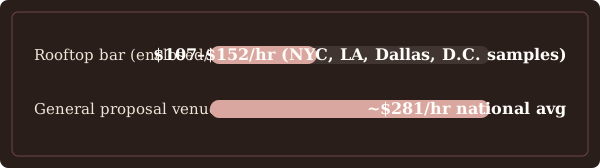
Marketplace data from CaratYes and Peerspace reporting puts the national average proposal venue rental at approximately $281 per hour, with city-level samples ranging from $200 in San Francisco to $266 in New York City. Most proposal bookings run two to four hours when you account for setup time.
Here’s a working breakdown of indoor venue types and what the research actually supports on cost:
| Venue Type | Documented Cost Anchor | Data Status |
|---|---|---|
| Rooftop bar (enclosed/heated) | $107–$152/hr (NYC, LA, Dallas, D.C. samples) | Marketplace samples, CaratYes |
| General proposal venue (Peerspace) | ~$281/hr national avg | Peerspace-based, CaratYes |
| Museum or library event room | Not established in research | Get local quotes |
| Greenhouse / conservatory | Not established in research | Get local quotes |
| Hotel suite or private ballroom | Not established in research | Get local quotes |
| Restaurant private room / buyout | Not established in research | Get local quotes |
The rooftop samples from CaratYes’s proposal cost guide are marketplace averages, not uniform industry rates: your city and specific venue will vary. Museum, greenhouse, and restaurant buyout pricing didn’t surface in the research with enough consistency to give a national number, so those require direct outreach to the venue’s events coordinator.
On top of venue time, the other line items to build in are: a hidden proposal photographer (documented range $200–$1,000 for one hour; most common range cited is $400–$800); an entry-level decor package if you want arch, candles, and a personalized sign (reported at approximately $1,150 for a bundled package); permit or insurance fees if required; and a 10–20% contingency buffer. Videography and florist-only package averages had no reliable 2025–2026 national figures in the research, so treat those as locally variable and get written quotes before building them into your number.
For anyone exploring Christmas proposal ideas specifically, note that holiday-adjacent venue bookings add another layer of competition: the same rooftop bar running a Christmas party might not have your Saturday available at any price.
Sorting through competing winter proposal ideas while also tracking vendor quotes is exactly the kind of thing that turns one spreadsheet into four. The free wedding planner has a budget tracker built in: use it to run your line-item scenario before you commit to anything.
How far ahead and what does it take to book indoor public venues (permits, insurance, approvals)?
For a municipal park example like NYC Parks, the documented minimum lead time is 21 days with a $25 non-refundable application fee; a separate guide references 30 days and a $100 processing fee for national park sites with ceremony-like setups. Both are examples, not universal rules: your city’s parks department and your specific park may differ significantly, so verify directly.
Here’s what the research supports by venue type, with honest flags on where the data runs out:
Parks and municipal venues: Expect at least 21 days for application in documented examples (NYC Parks). Fees in the cited example run $25 non-refundable. Check your local parks department website directly, because requirements vary by city, by event size, and by whether you’re hiring a commercial photographer (which some municipalities treat as a permitted commercial activity).
National Park sites: If you’re planning at an NPS location with decor, a hired photographer, or a structured gathering, the research references a 30-day minimum and $100 processing fee. Verify this with the specific park’s Special Use permit office before assuming it applies.
Museums, libraries, and conservatories: No reliable lead-time or fee data surfaced in the research for these venue types. Institutional approvals during winter and holiday season often move slowly. Budget 60–90 days for outreach, contract review, and approval, and get the venue coordinator’s written confirmation of what’s permitted before you pay any deposit.
Hotels and rooftop bars: Typically faster turnaround, but holiday blackout dates are real and specific to each property. Research gaps mean there’s no uniform timeline to cite: call the events desk and ask directly about December and February availability.
Insurance and COIs: Many public spaces and some private venues require a certificate of insurance for general liability. The research did not produce standard policy limits: they’re venue-specific. Ask the venue coordinator what limits they require before you book, then contact an event insurance provider for a quote. This part of planning any seasonal proposal catches people off guard because nobody mentions it until the contract arrives.
His Take: Read the permit language before the deposit clears, not after. Specifically, look for what triggers a permit requirement: some parks require one only for groups over 20, others the moment a commercial photographer is hired. If a clause is vague, email the office and get the clarification in writing. A $25 application fee you lose because you misread the rules is annoying; a $500 deposit on a venue that turns out to require an insurance certificate you don’t have yet is a different problem entirely.
How to prevent family and vendor friction: budgets, contracts, and scripts to keep a winter proposal from blowing up
The practical mechanics of winter proposal ideas: venue, photographer, permits: are actually the easier part. What consistently derails proposals is the people layer: who’s contributing money (and therefore feels entitled to input), who finds out before the moment, and what happens when a vendor’s holiday blackout date lands on your planned weekend.
Family funding and budget scenarios (these are original editorial templates, not validated research data):
Scenario A: No parental funds: Full budget is yours. Venue at ~$281/hr × 3 hours ($843), photographer ($400–$800), decor package (~$1,150 if desired), permit/insurance (variable), plus 15% contingency. No contribution conversations needed, no expectations to manage.
Scenario B: Partial conditional funding: A parent contributes toward the venue or ring; in exchange, they expect to know the plan in advance or be present at a celebration immediately after. Name that expectation explicitly in a conversation before you accept the money. “We’re grateful for this: we want to make sure we’re on the same page about what involvement looks like” is a sentence worth having now instead of after the moment.
Scenario C: Parents fund the venue only: They’ve earmarked a specific dollar amount for one line item. They’re not funding the photographer, the decor, or anything else. Keep the communication about their contribution to that scope. If they start expanding into guest-list opinions, that’s when you say “we really appreciate the venue contribution: the rest of the planning we’re handling ourselves.”
Guest-list politics and the surprise question: If you’re doing a true surprise, the only people who should know are those who have an operational role: the photographer, anyone helping with setup, and any family member whose absence would be suspicious and need covering for. If a financially contributing relative expects to be included, notify them 4–6 weeks before with a specific ask about confidentiality. Something like: “We’d love you to know, but we need you to sit on this completely: no hints, no half-mentions to anyone.” If that’s not realistic for the person you’re asking, consider a staged celebration dinner the evening of the proposal instead of including them in the moment itself.
Vendor contract clauses to ask for in writing (editorial templates: get your vendor to confirm their own language):
- Backup and reschedule clause: what triggers it, how much notice is required, and whether the fee changes
- Holiday blackout date language: explicit dates the vendor is unavailable, and what happens if they cancel
- Photography deliverables for low-light indoor settings: specific mention of indoor lighting plan or equipment if your venue is dim
- Explicit timeline for photographer presence: arrive X minutes before, remain through X minutes after
- COI requirement: whose insurance is whose, and who provides proof to whom
- Force-majeure wording: whether extreme weather, venue closure, or a public-health event qualifies and what it entitles each side to
Funny how the “non-refundable deposit” clause is always written in the largest font, while the backup plan section manages to fit on two lines in 8-point type. Ask for the rescheduling terms in plain language before you sign anything.
Bestie aside: The announcement going sideways with in-laws almost never happens because of a bad proposal. It happens because someone found out from someone else first, or because they expected an immediate group celebration that wasn’t planned. A five-minute “here’s what to expect in the next 24 hours” conversation with the people who are going to be first in the loop prevents the bulk of it. You don’t owe anyone a complete debrief before the moment, but telling your future mother-in-law “we’ll call you right after, before we post anything” costs nothing and saves an enormous amount.
Day-of backup checklist for winter specifically:
- Confirm a secondary indoor location if the primary venue is a public conservatory that might be crowded
- Block 2–4 hours including setup: don’t plan the moment for minute one of the booking window
- Confirm your photographer has a plan for low-light interiors (ask specifically what gear they’re bringing)
- Verify vendor staffing for holiday weekends: some photographers and planners use associate teams on high-demand dates; ask in writing who will actually be there
- If outdoor photos are part of the plan, keep that segment short and have warm layers staged nearby
If you’re also thinking about how the proposal connects to a small, intimate wedding afterward, the guide on how to plan a small wedding covers a lot of the same family-expectation and guest-list territory that starts here.

The plan works when the paperwork is done
The part nobody shows you in winter proposal content is all the moving pieces that have to align before the moment happens: the permit application submitted with enough lead time, the photographer briefed on the venue’s lighting, the family member who needed a direct conversation about what “just between us” means. Sorting through all of that while also managing the emotional weight of the moment is a lot.
The friction that derails winter proposal ideas isn’t usually the weather or the venue. It’s the gap between what you assumed was handled and what you actually confirmed in writing. Conditional parental funding that came with unspoken expectations. A vendor contract without a rescheduling clause. An in-law who found out sideways and decided that meant they had standing to weigh in.
When you’re ready to take all the moving pieces (venue research, vendor quotes, timeline, budget scenarios) and put them somewhere they won’t live in six different browser tabs, the BigDay Classic Edition was built for exactly this kind of multi-layer planning. It gives you the structure to run the proposal planning and the wedding planning without losing track of what’s confirmed and what’s still a verbal agreement.
The greenhouse will be beautiful. Get the paperwork right first.
FAQ: Winter proposal planning
Is winter the most common time to get engaged?
Yes, by a significant margin. The Knot’s 2025 Real Weddings Study reports approximately 47% of all engagements happen between November and February: making that four-month stretch the single most concentrated period of the year for proposals. The concentration is real enough that it meaningfully affects vendor availability and venue booking windows during that window.
How much should I budget for an indoor proposal venue and vendors?
Based on marketplace data from CaratYes and Peerspace reporting, the national average proposal venue rental runs approximately $281 per hour, with city samples ranging from $200 (San Francisco) to $266 (New York City) per hour. Most bookings run two to four hours. Add a hidden proposal photographer at $400–$800 for one hour (the most commonly cited range), and an entry-level decor package at approximately $1,150 if you want arch, candles, and signage. Videography, florist-only packages, museum rentals, and conservatory fees did not have reliable 2025–2026 national averages in the research: treat those as locally variable and get written quotes from vendors in your specific city before finalizing your number.
How far in advance do I need permits or approvals for public indoor venues?
It depends on the venue type and municipality, but concrete examples exist for two cases. NYC Parks has a documented minimum of 21 days for a Special Events Permit, with a $25 non-refundable application fee. A separate guide references a 30-day minimum and $100 processing fee for national park sites that involve decor, a hired photographer, or an assembled group. For museums, libraries, and conservatories, no uniform timeline surfaced in the research: contact the venue’s events coordinator directly and allow 60–90 days during winter and holiday season for institutional approvals. Hotels and rooftop bars typically move faster but watch for holiday blackout dates.
What do couples most commonly run into when planning winter proposals?
Forum discussions point to a few recurring patterns. Cold exposure is the most concrete: one thread described a proposal in about 12-degree weather where the couple was outdoors for roughly ten minutes before moving to a warmer indoor spot; another described a late-January Central Park proposal at 30 degrees and windy. Public indoor venues like conservatories solve the weather problem but can introduce crowding: one Toronto discussion flagged Allan Gardens as attractive but potentially busy. Photography logistics also come up: arranging someone to capture the moment is frequently mentioned as an afterthought. The research did not surface adequately documented data on holiday-family interference, low-light photography failures, or vendor blackout date conflicts: those are real planning concerns, but they can’t be claimed as statistically frequent based on what the sources showed.