
Your wedding countdown app just flipped to single digits, and you’re staring at a 60% chance of rain on your date, telling yourself a tent is probably overkill. It isn’t, but “probably fine” is not a plan, and finding that out at 7am on your wedding day is a very specific kind of awful.
We know because we’ve watched it happen. Our friend Clara booked a stunning vineyard venue in the Hudson Valley, spent months on her florals, her lighting, her timeline, and did zero paperwork on a weather backup until ten days out. The venue had an “approved vendor” tent company. One package, $1,900 minimum, take it or leave it. She took it, obviously, because what else do you do with nine days left? Then came the add-ons: sidewalls, flooring for the saturated grass, delivery labor. The tent itself was the cheap part. A outdoor wedding rain plan is not something you assemble the week before the wedding, and that’s exactly what this guide is for.
How much will a practical outdoor wedding rain plan actually cost in 2025–2026?
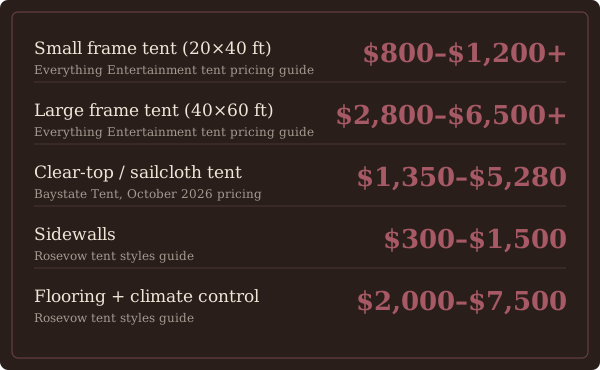
There is no verified national average for a complete weather backup: delivery, labor, anchoring, permits, and taxes are calculated per project, and regional variation is significant. Published equipment-only ranges from rental guides show frame tents starting around $800 for a small 20×40 setup and running to $6,500 or more for a large 40×60 high-peak frame, per Everything Entertainment’s tent rental pricing guide. Add-ons push the real number higher fast.
Here’s what the line items actually look like when you price one out:
| Item | Published range | Source / caveat |
|---|---|---|
| Frame tent (20×40) | $800–$1,200+ | Equipment only; delivery/labor extra |
| Frame tent (40×60) | $2,800–$6,500+ | Equipment only |
| Pole tent (40×80) | $800–$2,000 | Secondary article; not a national price list |
| Clear-top / sailcloth tent | $1,350–$5,280 | Baystate Tent regional pricing, Oct 2026 |
| Sidewalls | $300–$1,500 | Secondary sources; complete enclosure |
| Hardwood or padded flooring | $1,500–$5,000 | Secondary sources |
| Lighting and AV | $500–$5,000+ | Wide range by complexity |
| Climate control / heaters | $500–$2,500 | Secondary sources |
| Delivery, installation, labor, anchoring | Project-specific | Not separately quantified; get a line-item quote |
Two rough scenarios, based on secondary source estimates (not verified national averages): a modest 100-person plan with a basic frame tent, sidewalls, and simple flooring lands somewhere in the $5,000–$8,000 range all-in. A fully outfitted 150-person setup with hardwood flooring, full sidewalls, string lighting, and climate control can reach $12,000–$25,000 before catering, per the ranges Rosevow’s wedding tent styles guide cites. Call two local tent companies for actual quotes: those secondary figures are directionally useful, nothing more.
One thing the research could not pin down: a reliable per-guest contingency number. Some planning sources mention roughly 5% of the total event budget as a weather reserve, per Texas Old Town’s rain planning guide, but that’s editorial guidance, not a surveyed industry standard. What is clear from real forum discussions: deposits alone can exceed $1,000, and you may owe them before you know whether it’ll rain. Budget as if the tent is happening and treat sunshine as the refund.
What do couples actually report goes wrong when they try to execute a rain backup plan?
The two most consistently documented problems are cost surprises and venue-mandated vendor restrictions that remove your pricing choice entirely. Forum discussions confirm both patterns repeatedly, though broader failure rates and quantified guest-impact data simply weren’t available in the research, so this section focuses on what can actually be verified.
Verified pain points from forum evidence:
- Unexpected cost exposure: One poster reported a tent costing over $5,000 with a nonrefundable deposit above $1,000. That’s not a worst-case outlier: it’s what a mid-size frame tent with flooring and sidewalls actually costs once delivery and labor are added.
- Venue-exclusive tent vendors: A separate forum thread described a venue that required use of their designated tent company, with the lowest available package at $1,900. If your contract doesn’t surface this requirement before you sign, you’re negotiating from zero leverage with nine days left.
- Availability pressure forcing early deposits: Discussions on r/Weddingsunder10k describe couples placing deposits to reserve equipment while waiting on the forecast, because waiting too long risks losing the rental entirely. So you’re committing real, likely nonrefundable money to something you hope you won’t need. Funny how the “non-refundable” clause is always written by the side that gets to keep it.
- Logistics that forums discuss but nobody quantifies: Guest mobility on saturated ground, humidity damaging florals, and acoustics inside enclosed tents all come up in anecdotal threads. Hard data on how often these cause real problems wasn’t retrievable: flag them in your planning conversations with vendors.
A good outdoor wedding rain plan accounts for the friction before it’s live, not after. One mitigation checklist worth keeping in your back pocket: reserve the tent early (before the forecast is relevant), get written confirmation of who owns the move-in timeline, and pre-agree on how vendors will be notified if you flip to the backup. Simple, but very few couples have all three documented before the week of.
For couples doing this while managing everything else on a tight budget, this breakdown of how to plan a wedding on a tight budget is useful for thinking about where weather contingency fits in the larger spending picture.
Bestie aside: The flooring line item is the one that breaks people. You price the tent, you think you’re done, and then the rental company mentions that their crew won’t set up on saturated grass without a pad or hardwood base, and suddenly you’re adding $1,500 to $5,000 to a number you already felt okay about. Get the flooring quote before you agree to anything. It’s not optional on a wet-ground site.
When should you lock rentals and what exact weather triggers should flip you to the backup plan?
Lock your tent rental as soon as you’ve confirmed your venue, not when the forecast looks questionable. Planning resources support a 1–2 week full operating review with your venue and vendors, followed by a 72-hour forecast checkpoint as the primary decision window, per Texas Old Town’s rain-day planning guide. A 70% precipitation probability is commonly cited in planning sources as a switch trigger, but no meteorological standard backs that specific number: treat it as a starting point for a conversation with your venue, not a hard rule.
A workable decision timeline for your outdoor wedding rain plan looks like this:
- As soon as the venue is booked: Ask whether they have an approved or exclusive tent vendor. If yes, get that package pricing immediately. If no, contact at least two local tent companies for quotes while your date still has full availability.
- 1–2 weeks before: Full operating review. Walk through guest movement, setup sequence, décor placement, and the backup activation process with your venue coordinator and key vendors, per Oak Creek Farm’s outdoor wedding checklist. Finalize your layout for both the primary outdoor setup and the backup configuration.
- 72 hours before: Primary forecast checkpoint. Review precipitation timing, wind, temperature, and ground saturation conditions. This is when you should be making the go/no-go call, not morning-of.
- 24 hours and 12 hours before: Daily updates with increasing frequency. By this point, your decision-maker should already be named, and vendors should already know what a “flip to backup” call looks like from you.
- Lightning, always: The National Weather Service is clear that outdoor events need a designated shelter and a defined stop-and-resume procedure when lightning is in the area. Don’t wait for a threshold number: when lightning is in the forecast, the shelter plan activates, period.
On wind speed, lightning distance, and precipitation percentage: the research didn’t return specific meteorological thresholds you can put in a contract. Contact your local NWS office or ask your venue’s safety coordinator for site-specific guidance. These aren’t details to fill in with editorial guesses.
His Take: Name one person as the weather decision-maker and put it in writing before the week of the wedding. Not “us,” not “we’ll figure it out together”: one person with the authority to make the call. When you’re running on no sleep and watching the radar at 6am, you don’t want a group vote. We’ve seen couples freeze at exactly that moment because nobody knew whose job it was. Pick someone. Write it down.
What must you put in vendor contracts now so you aren’t left paying for last-minute changes?
The research didn’t surface standard sample clauses from wedding planners or venue managers: that’s a genuine gap, and if you’re working with a planner, ask them to walk you through their specific language. What the available evidence does establish clearly: the contract topics below are the ones that determine whether you’re protected or exposed when you actually need the backup plan.
Your outdoor wedding rain plan is only as solid as the contracts behind it. Here’s what each vendor agreement needs to address:
- Decision authority and notification process: Who has final authority to activate the backup plan? Who is responsible for notifying the tent company, caterer, florist, officiant, and AV vendor? Get the process (and the timing) written into the contract, not just verbally agreed. Per both Oak Creek Farm’s checklist and Texas Old Town’s guide, this is the single most commonly undocumented element.
- Explicit cost breakdown for backup activation: Which charges apply if you flip to the backup? The contract should name tent, sidewalls, flooring, heaters, generators, delivery, labor, anchoring, ballast, and permits individually. “Included” and “extra” need to be defined in writing, not assumed.
- Deposit and nonrefundable fee language: What happens to your deposit if the backup isn’t needed? What happens if you need to postpone entirely? Forum examples show deposits above $1,000 being committed before the forecast is even relevant. Know exactly what’s nonrefundable before you sign.
- Venue-exclusive vendor disclosure: If the venue requires you to use their designated tent company, that needs to be surfaced and in writing before you sign the venue contract, not discovered nine days out the way Clara did.
- Vendor arrival and installation windows: What time does the tent company arrive? What’s the contingency if they’re late? Get a signed move-in and move-out schedule with the venue. Installation logistics affect final pricing, per Baystate Tent’s published notes, and a late setup can cascade into ceremony delays.
On insurance and liability: ask every vendor for proof of liability insurance and clarify who’s responsible if something goes wrong during setup or the event. The research didn’t return standard 2025–2026 insurance thresholds, so treat this as a conversation to have directly (and in writing) with each vendor and your venue.
If you’re navigating this kind of vendor paperwork across a broader planning process, this vendor planning guide covers the contract conversations worth having before you’re in the thick of it.

The Catch: Delivery, labor, anchoring, and permits are almost universally calculated per project and billed separately from the tent equipment price, which means the number on the rental company’s website is not your actual number, and the gap between those two figures is where most couples get surprised.
Put it on paper before the forecast is even relevant
The couples who get through a rainy wedding day without a financial meltdown are almost always the ones who locked the tent company, confirmed the backup layout, and settled the contract language months before the 72-hour checkpoint. The outdoor wedding rain plan isn’t a last-week task: it’s a first-month one, and leaving it later doesn’t save money, it just means you negotiate from a worse position.
If you’re trying to track the tent deposit alongside your catering contract, your flooring quote, and the seventeen other things your vendor list currently contains, BigDay’s Classic Edition wedding planner is built for exactly that kind of parallel juggling. It’s where you put the “who has final call on the weather decision” note so it doesn’t live only in a text thread nobody can find at 6am. Get it documented before the countdown hits single digits.
FAQ
How much does a tent and basic weather kit actually cost?
Equipment-only pricing for a frame tent runs $800–$1,200 for a 20×40 setup and $2,800–$6,500+ for a 40×60 high-peak frame, per Everything Entertainment’s rental pricing guide. Add sidewalls ($300–$1,500), flooring ($1,500–$5,000), and climate control ($500–$2,500) and the all-in number climbs significantly. Delivery, labor, and anchoring are billed separately: always request a full line-item quote.
When should we make the final call to move the event inside?
The 72-hour forecast checkpoint is the primary decision window most planning sources support. A precipitation probability of around 70% is commonly cited as a trigger, but it’s not a verified meteorological standard: use it as a starting point, then confirm a specific threshold with your venue and vendors. Don’t wait for morning-of to have this conversation: the decision-maker and notification process should be named in advance.
Who typically pays for tents, delivery, and setup if we switch to the backup plan?
There’s no industry standard: this is entirely determined by what your contracts say. The tent company, venue, and any other affected vendors each have separate agreements, and “who pays if it rains” is rarely the default language. Before you sign anything, get written confirmation of which charges (tent, sidewalls, flooring, heaters, delivery, labor, permits) apply if the backup plan activates, and who is responsible for each.
How much lead time do we need to reserve tents, flooring, and generators?
No reliable national lead-time data was available in the research: local capacity varies too much to give a single number. What forum discussions do confirm: waiting until the forecast looks uncertain is too late. Some couples place a deposit months out to secure availability and treat the reservation as insurance. Call two local tent companies early in your planning process and ask directly about their booking windows for your date.
Related: 3 How To Plan A Small Wedding: Avoid Costly Mistakes Today.