
You’re three weeks out from a date change you haven’t announced yet, and your phone is showing seventeen unread texts from vendors while you try to figure out which one to call first. The common assumption is that postponing is simpler than cancelling: you’re not walking away, so surely everyone will just… work with you.
They might. But your deposits, your insurance claim, and your new date will all be decided by contract language you may not have read since the week you signed, not by goodwill. That gap between what you assume and what’s actually in writing is where money disappears.
We know this because we watched it happen in real time from a friend’s living room: well, a Zoom call from wherever we were that month. She was in Auckland, her vendors were in Toronto, and she’d woken up at 2 a.m. her time to start calling caterers. She had no idea which vendor to contact first, whether to mention the insurance policy she’d bought, or whether sending a single email to everyone at once would somehow trigger a cancellation clause. The sequencing question was eating her alive. What we walked her through then is exactly what this guide covers: how to postpone a wedding without accidentally forfeiting the money you’ve already paid.
What do we actually know about how often couples postpone vs. cancel, and what we don’t?
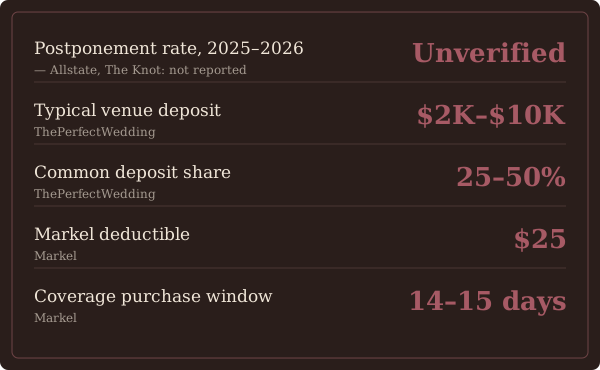
No reliable 2025–2026 national statistic exists for what percentage of couples postpone rather than cancel, how long postponements typically run, or how many months dates shift on average. If you’ve seen a confident percentage somewhere, treat it as unverified. Neither The Knot’s wedding insurance coverage nor any major industry survey in current circulation reports a defensible, representative number.
That matters practically: you can’t look at a “norm” and calibrate your expectations. There is no market baseline telling you that vendors usually transfer deposits within 30 days or that most couples find a new date within six months. What actually controls your outcome is the specific language in each contract you signed and the definitions in your insurance policy.
What insurers do report reliably is that event-cancellation and postponement coverage exists and may reimburse nonrefundable deposits, but only when the cause of postponement is a covered event under the policy. Allstate, Markel, and Progressive all describe this coverage in procedural terms: the cause must meet the policy’s definition, exclusions apply, and you must notify promptly. “Change of mind” is not a covered cause. Vendor bankruptcy, extreme weather, military deployment, and government orders may be, depending on your specific policy.
The practical implication: approach postponement vendor by vendor, contract by contract. Don’t assume standardized refund windows or deposit transfer rules exist across your vendor list: they don’t. Before your next call, pull together your original contracts, all payment receipts, your insurance policy, and any correspondence. That file is your starting point, and building it now costs nothing.
Who do you contact first, and how do you protect your deposit in the first 48 hours?
Contact your venue and planner first. The venue controls the date itself, and the planner (if you have one) manages the downstream vendor relationships: those two calls shape every other conversation. Then work through photographer, caterer, officiant, entertainment, florist, rentals, and hotel-block provider, in roughly that order. Priority tracks deposit size and rebooking difficulty: a venue or photographer with a Saturday in high season is almost impossible to replace on short notice; a florist has more flexibility.
Figuring out how to postpone a wedding without losing what you’ve paid comes down to the speed and precision of these first communications. Markel and Progressive both state explicitly that you should notify your insurer immediately and should not sign release forms or settlement agreements before checking what documentation the insurer requires. That instruction applies to vendors too: do not sign anything that says “cancellation” or “forfeiture” while this is still in motion.
For each vendor, send a written request within 48 hours. Use this structure:
Subject: Written request to postpone [your names] wedding from [original date]
- Available replacement dates
- Whether all payments transfer to the new date
- Any rescheduling fee, pricing, or minimum-spend changes
- The deadline for selecting a new date
- What happens if no mutually acceptable date is available
- The contract clause governing this request
Close the email by asking the vendor to place the booking on hold and confirm in writing that no forfeiture or cancellation action will occur before a date you specify: 10 to 14 days out is a reasonable window to request, though no verified market standard exists for this. If you spoke by phone first, follow it immediately with an email summarizing what was said: “Per our call today, you confirmed X. Please reply to confirm this in writing.” That email thread is evidence.
One timing flag the research supports: if your contract contains a specific written-notice deadline for postponements, that deadline controls. Send notice before it expires. If the contract is silent on timing, written notice now is still your best protection: it creates a documented record that you requested postponement rather than triggering cancellation.
Bestie aside: The 2 a.m. panic spiral of “which vendor do I call first” is real, but the answer is simpler than it feels: venue, then planner, then everyone else in writing. You don’t have to have the new date figured out before you make contact. “We need to postpone, here are our questions” is a complete first message.
What must you get in writing in the first two weeks: an amendment checklist and sample clauses
Every vendor postponement needs a signed written amendment before you consider it settled. No amendment, no transfer: a verbal “we’ll work with you” does not secure your new date, does not lock transferred payments, and gives you nothing to show an insurer. Verbal promises also won’t survive a vendor ownership change, a staff turnover, or a dispute six months from now.
Understanding how to postpone a wedding in a way that actually holds up means knowing exactly what each amendment must contain. Here’s the checklist:
| Amendment Item | Why It Matters |
|---|---|
| Original date stated explicitly | Prevents any ambiguity about which booking is being modified |
| New date (or approved date range) | Confirms what you’re holding and for how long |
| Payments already made, itemized | Creates the baseline for what transfers |
| Amount confirmed as transferred | The number you’re protecting |
| Any new fees or price changes disclosed | Prevents surprise invoices later |
| New payment deadlines | Keeps you from defaulting on a revised schedule |
| Who signs and when | Amendment is not effective until both parties execute it |
| Explicit release of original date only upon signing | Stops vendor from re-booking your original date before ink is dry |
Watch the language in vendor replies carefully. Words like “nonrefundable,” “retainer,” and “forfeited” each carry distinct legal meanings that vary by jurisdiction, and a vendor who uses them loosely may be signaling that they intend to retain your payment regardless of what they agreed verbally. If a vendor asks you to sign a “credit note” or a release before an amendment is in place, that document can affect both your insurance claim and any chargeback option you might otherwise have. Ask for a written explanation citing the specific contract clause before signing anything.
Sample language is below, labeled as drafting examples, not legal advice. Have local counsel review enforceability questions in your jurisdiction: the research did not surface attorney commentary specific to 2025–2026 or any particular state.
Force majeure clause (sample, not legal advice): “Neither party will be liable for failure or delay caused by events beyond reasonable control, including government restrictions, venue closure, natural disaster, epidemic, or other events making performance illegal or impracticable. The parties may postpone to a mutually agreed date, and payments will be applied to that date.”
Rescheduling clause (sample, not legal advice): “Client may request one date change by written notice no later than 180 days before the event. Amounts paid will transfer to one replacement date within 12 months, subject to vendor availability, with incremental costs disclosed before acceptance.”
If a vendor refuses to amend at all, escalate in two tiers: first, request a written explanation citing the specific contract clause and preserve every document; contact your card issuer about chargeback options and your insurer before signing any release. Second tier, if that stalls: your state or local consumer protection agency, small-claims court for amounts within its limit, or legal counsel. Research did not surface jurisdictional enforcement rates, so approach escalation conservatively and document everything.
For tracking all of these vendor conversations and deadlines in one place rather than across a dozen email threads, the free BigDay wedding planner has a checklist and budget tracker built specifically for this kind of vendor-by-vendor reconciliation.
How does insurance handle postponements vs. cancellations: what to file, when, and what evidence insurers want?
Event-cancellation insurance may reimburse nonrefundable deposits when a covered cause triggers the postponement or cancellation, but coverage is policy-specific, not guaranteed, and it is not a substitute for contract negotiation. Allstate and Markel both advise immediate reporting; Markel notes a $25 deductible per coverage area and states that some event-cancellation coverages may be purchased up to 14 to 15 days before the event. Progressive is explicit that coverage must be in place before the postponement event occurs and before you file a claim.
When you notify your insurer, have this documentation ready or in progress:
- Original signed contract with each vendor
- All payment receipts and confirmations
- Your written postponement request to each vendor
- Written vendor statements showing amounts retained, the contractual basis for retention, and whether the service is transferable
- Proof of the covered cause (doctor’s note, government order, military deployment papers, bankruptcy notice)
- The claim form itself, with each expense tracked separately against the policy’s limit and deductible
Do not cancel vendors or sign deposit-release agreements before your insurer tells you what it needs. Signing a release that says you accept a partial refund “in full settlement” can close off your ability to claim the remainder.
Common exclusions to read carefully: “change of mind” is not covered under any standard event-cancellation policy. Coverage is limited to defined causes (illness, deployment, bankruptcy, severe weather, government orders) and policy definitions control whether your specific situation qualifies. Request written claim decisions and written explanations for any excluded amount; those letters matter if you need to escalate or dispute.
One honest caveat: no verified 2025–2026 statistics exist on what percentage of postponement claims are approved, what insurers pay out on average, or how often rescheduling fees are covered. If someone cites those numbers, ask for the source. Frame insurance as one risk-mitigation tool among several, not a guaranteed recovery path. If your insurer denies coverage, the card chargeback and consumer-protection paths described in the previous section remain available.
His Take: The insurance step is the one people skip because it feels bureaucratic and they’re already overwhelmed. But the insurer’s instructions actually simplify the vendor conversations: once you know what documentation the insurer needs, you know exactly what to demand in writing from each vendor. Do the insurance call first. It clarifies everything downstream.

Your next 48 hours, in order
Knowing how to postpone a wedding without forfeiting your deposits comes down to one thing: sequencing. Here’s what to do now, before anything else.
Step 1: Pull your file. Gather every vendor contract, all payment receipts, your insurance policy, and any existing correspondence. If something is missing, request it in writing from the vendor today: don’t negotiate without it.
Step 2: Notify your insurer before you sign anything. Ask what documentation they need and whether your cause of postponement qualifies as a covered event. Do not release a vendor or accept a partial settlement until you have that answer in writing.
Step 3: Send written postponement requests to your venue and planner today, then work through your full vendor list. Use the email structure above. Request a written hold on your date. Every vendor, every payment transfer, every fee change needs a signed written amendment before it’s real.
If you’re managing this across multiple vendor threads and trying not to lose track of who’s confirmed what, the BigDay Classic Wedding Planner has the vendor tracking, budget reconciliation, and amendment checklist built in: designed for exactly this kind of moment when the logistics are moving faster than a spreadsheet can keep up. And if you’re in the middle of building out your vendor list in the first place, our breakdown of wedding vendor guide mistakes to avoid before you sign is worth reading before your next contract lands in your inbox.
Frequently asked questions
Will insurance reimburse my deposit if we postpone the wedding?
It depends on your policy and the cause. Event-cancellation coverage from insurers like Allstate and Markel may reimburse nonrefundable deposits when a covered cause (illness, military deployment, severe weather, vendor bankruptcy) triggers the postponement. Coverage is not automatic, limits and deductibles apply, and you must notify promptly. “Change of mind” is excluded under every standard policy we’ve seen.
What counts as a “force majeure” reason to postpone, and does it guarantee my money back?
Force majeure clauses vary by contract: there is no universal definition. Common qualifying events include government restrictions, natural disasters, epidemics, and venue closures, but whether a specific situation triggers the clause depends on how it’s worded in your contract. It does not automatically guarantee a refund; it may create a postponement mechanism. Read the clause alongside your insurance policy’s covered-cause list before relying on either.
How should I word a postponement request so my vendor can’t simply keep my deposit?
Send a written request immediately, asking for: available replacement dates, confirmation that payments transfer, any rescheduling fees or price changes, the deadline for selecting a new date, what happens if no mutual date is available, and the specific contract clause governing the request. Ask the vendor to place the booking on hold and confirm no forfeiture will occur while the request is under review. Get everything confirmed in a signed written amendment, not a verbal agreement, not a text thread.
If a vendor refuses to reschedule or return money, what are my next steps?
First, request a written explanation citing the specific contract clause. Preserve all records and contact your insurer before signing any release. Then consider: a chargeback with your card issuer (document the refusal), your state or local consumer protection agency, small-claims court for amounts within its limit, or legal counsel. Research did not surface jurisdictional enforcement rates, so escalate conservatively and document every step. Do not sign a release or “full settlement” document while any of these paths remain open.
Related: How To Avoid The Wedding Planning Checklist Mistake.
Related: Legal Things to Do After Getting Married: Avoid Mistakes.